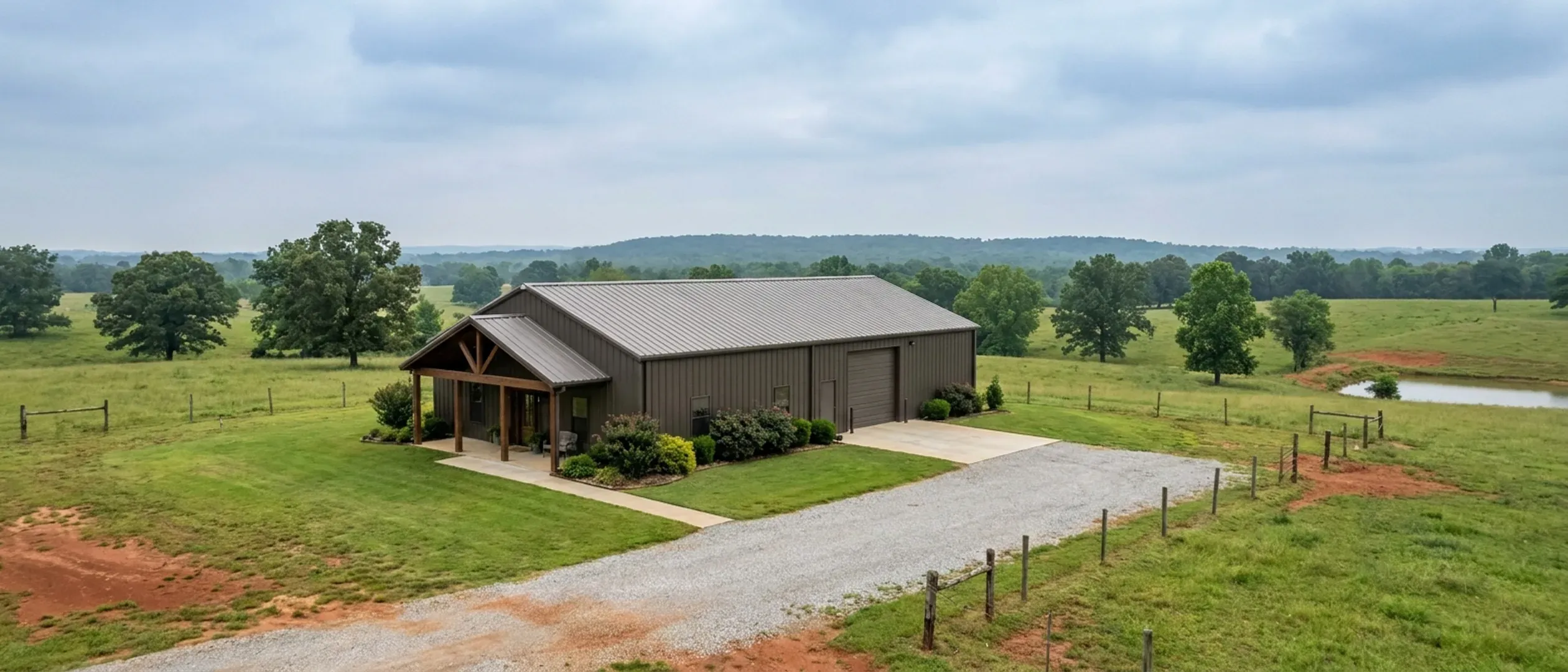
Financing a Barndominium in Arkansas
Barndominium financing is the most commercially contested question on this subject, and the pages competing for it are mostly lead forms. What follows instead is the mechanism. A lender does not decline a post-frame or steel-framed house because of what the walls are made of; it declines, or conditions, on three things it can name — whether an appraiser can support the value with closed sales, whether the money can be structured across a construction period without the borrower carrying two loans, and whether the finished building can be documented as a legal, habitable, marketable dwelling. In Arkansas the third one is where the state stops being ordinary. Of the twelve Arkansas counties researched for this site, one runs a building department for its unincorporated land. Garland County states on its own addressing page that the county does not issue any type of Certificate of Occupancy. That is a financing fact before it is a building-code fact, and it is the part of this subject nobody else writes down.
Figures on this page are cited third-party or government data, not a quote from Arkansas Barndominium Builders.
How the money is structured, and where a barndominium strains it
Nearly every one of these projects is a construction loan that becomes a mortgage. The published rules for that conversion are specific, and reading them in advance settles most of what a borrower is otherwise told to guess about.
Single-closing construction-to-permanent, and how the ratio is calculated
Fannie Mae's Selling Guide at B5-3.1-02 covers conversion of construction-to-permanent financing in a single-closing transaction, and its arithmetic is published rather than negotiable. For a purchase, the loan-to-value ratio is the loan amount divided by the lesser of the purchase price — the sum of the cost of construction and the sales price of the lot — or the as-completed appraised value of the property, lot and improvements together. That is the sentence to read twice, because it is where a barndominium's appraisal risk becomes a cash-at-closing risk. If the as-completed appraisal lands below cost plus lot, the ratio is calculated off the appraisal and the difference is made up by the borrower. The section also sets terms for the construction period, requires an appraisal update at conversion, and requires borrower requalification where the property value declines, credit documents were updated or loan terms changed.
Twelve months is the structural deadline
The same section limits the construction loan period on a single-closing transaction: the guide gives examples of three six-month periods, one twelve-month period and similar structures, and states that where the construction loan period, or a subsequent extension, exceeds those requirements the lender must process the loan as a two-closing construction-to-permanent transaction to be eligible for sale. After conversion the permanent loan must have a term not exceeding thirty years, disregarding the construction period. For this building type that deadline lands on a real habit. Staged finishing — dry in the shell now, finish the shop bay later — is the genuine budget lever on a barndominium, and it is in direct tension with a twelve-month construction window and an as-completed appraisal of a building that is not yet complete. The resolution is to define completion at the loan's scope and put the deferred work outside it, not to assume the clock will stretch.
The land comes first, and in Arkansas it is a large early number
Almost every rural barndominium project begins with a piece of ground that no construction lender will pay for. USDA NASS, in its Land Values 2026 Summary, puts Arkansas farm real estate at $4,350 an acre, cropland at $3,850 and pasture at $3,500. The 2022 Census of Agriculture's county figures spread far wider than that, putting agricultural land and buildings at $9,796 an acre in Benton County against $2,085 in Dallas County. On ten acres the same purchase is a different order of magnitude at each end, and it is usually the borrower's own cash, a seller-financed note or a separate lot loan rather than part of the construction facility. Where the lot is being bought at the same time as the build, note that B5-3.1-02's purchase arithmetic explicitly adds the sales price of the lot to the cost of construction — so a lot bought well is worth ratio points, and a lot bought badly is not rescued by the appraisal.
The appraisal, which is where the loan is really decided
A barndominium loan is rarely refused on the loan application. It stalls at the value, and it stalls for reasons that are written down and can be prepared for.
Three closed sales, and a preference for recent ones
Fannie Mae's B4-1.3-08 requires a minimum of three closed comparables in the sales comparison approach and allows additional comparables to support the opinion of value. On age, it states that comparable sales within twelve months should be used, while making the point that the best and most appropriate comparables are not always the most recent — a nine-month-old sale with a time adjustment may beat a one-month-old sale requiring multiple adjustments. Where there are no sales in the preceding twelve months, the appraiser may use older comparables and explain why. In a rural Arkansas county with a thin transaction record and an unusual building type, all three of those allowances are likely to be in play at once, and each of them is an explanation the appraiser has to write. Giving them the material to write it is the borrower's highest-leverage act in the whole process.
Distance is allowed, and it must be stated precisely
The same section's Rural Properties subsection permits comparables a considerable distance away where the market data shows they are the best indicators of value and the result is credible, with an explanation of why they were selected. It also requires the appraiser to be specific about proximity in miles with a directional indicator. That combination is what makes a rural Arkansas comp set defensible rather than arbitrary: not the nearest three sales, but the three most similar sales with the distance stated and the reasoning on the page. If a lender's own overlay imposes a tighter mileage limit than the guide does, that is the lender's policy rather than the secondary market's requirement, and it is worth asking about explicitly before an application.
Highest and best use, as improved
B4-1.3-04 requires the appraisal to reflect the highest and best use of the site as improved, and defines the test: the improvements must be legally permitted, financially feasible and physically possible, and must provide more profit than any other use of the site would generate. The analysis considers the property as it is improved, and where comparable sales show the improvements are reasonably typical and compatible with market demand for the neighbourhood, and the improved value exceeds the vacant site value, the existing use is reported as the highest and best use. On a large acreage parcel with a modest dwelling and a large shop, that test is doing real work, and it is another reason the shop-to-dwelling proportion is a valuation decision.
Unpermitted work has its own heading
The guide does not pretend unpermitted construction does not exist. B4-1.3-05 carries a subsection headed Additions without Permits, requiring that where the appraiser identifies an addition that does not have the required permit, they must comment on the quality and appearance of the work and its impact, if any, on the market value. The operative words are required permit. Where a county issues none, none was required — which is a materially different position from work done in defiance of a permit requirement, and it is worth having the county's own published statement in the file to establish which situation the property is in. Washington County puts it in an ordinance: Ordinance 2025-044 § 5(P) deems building permits issued for agricultural and single-family residential uses.
Where the frame type genuinely does not matter
Two things are worth saying plainly because the internet muddles them. A site-built barndominium is not manufactured housing, and Arkansas's own instruments say so from two directions: Volume III of the Arkansas Fire Prevention Code deletes the manufactured-housing appendix in its entirety, and the Arkansas Energy Code at § 101.5.2 exempts mobile homes and manufactured housing outright, which only makes sense because a site-built dwelling is not one. And the residential code's scope covers detached one- and two-family dwellings by use rather than by framing system. Establishing the category with drawings, a foundation design and a permanent-foundation detail removes the objection that costs the most at appraisal — the objection that this is a building rather than a house.
Financing on land where nobody inspects
This is the Arkansas-specific half of the subject, and it is where the ordinary advice runs out. The response to an absent building department is not to look for a permit. It is to build the record the permit would have created.
Find out what your county actually issues, and get it in writing
The answers vary more than anyone expects, and several are less than two years old. Benton County runs a building operation with a published fee ordinance and a Barndominium/Shouse checkbox on its own residential application. Washington County zones every unincorporated acre and deems the permit issued for single-family residential use. Pulaski County issues a building permit inside the Lake Maumelle watershed and nowhere else. Garland County, Faulkner County, White County, Saline County, Sebastian County, Craighead County, Lonoke County, Madison County and Carroll County issue no county residential building permit at all. The county's own published statement of that fact belongs in the loan file, because it converts an apparent omission into a documented jurisdictional position.
Substitute an engineer for the plan reviewer
A sealed structural design for the foundation, frame, connections and anchorage is the single most valuable document on an unpermitted rural build, and it is worth more there than inside a permitted city rather than less, because there is no public record standing behind the work. It also answers a question rural Arkansas cannot answer from a table: the residential code leaves the climatic and geographic design criteria as a local fill-in, and most Arkansas jurisdictions publish nothing, so someone has to choose the design loads and that someone is an engineer. Where a jurisdiction does publish, use its numbers and no one else's — Rogers publishes a full block including a 105 mph ultimate design wind speed, 15 psf ground snow, Seismic Design Category B and an 18-inch frostline, and none of those figures has any application on a site in another jurisdiction.
Substitute a documented inspection trail for the inspection sequence
The code names the milestones even where nobody attends them: foundation, plumbing, mechanical, gas and electrical, floodplain where applicable, frame and masonry, fire-resistance-rated construction, and final. Engaging an engineer or a third-party inspection agency at those same points produces a dated, signed record in the shape a reviewer expects. Add photographs of footings and reinforcement before the pour, of anchorage and column bases, of framing connections, and of every rough-in before it is covered — each one dated and located. Where a building official does exist, the Arkansas Fire Prevention Code's [A] 105.3.3 allows a permit issued in reliance on an affidavit, with the engineer or architect supervising the work and filing a written completion affidavit at the end; that document is a useful model for the file even where no permit was issued.
Collect the approvals that do exist, because several do
A county with no building department still generates paperwork, and every piece of it is worth keeping. The Arkansas Department of Health onsite wastewater permit is statewide and independent of any building permit, and its Permit for Operation under § 4.10.3 is issued after an installation inspection. The 911 address assignment is a real gate — Sebastian County provides at § 90.04 that no person may authorise a utility to supply a new residence until an address has been assigned or approved by the County Judge or a designee, and Carroll County has had a rule since 2008 under which the power company will not extend a line to an address the county's 911 mapping office has not certified. Where the parcel touches a Special Flood Hazard Area in a participating community there is a floodplain development permit and, for new construction in a mapped zone, an Elevation Certificate. And the electrician's and plumber's state licences and any trade inspections exist whether or not a building official does.
Programmes and lenders that reach rural Arkansas
Where a page names a programme it should also name the instrument that creates it, because programme names change and statutes do not. These are the frameworks; eligibility for a specific address is determined by the administering agency, not by a web page.
The federal single family rural housing authority
Title V of the Housing Act of 1949 is codified at 42 U.S. Code § 1471 and following. Section 1472 carries the single family loan authority, including at subsection (h) the Rural Housing Service loan guarantee, and subsection (i) caps at $50 per loan the fee the Secretary may assess for a lender to access the Department's automated underwriting systems. Two features matter on Arkansas ground. Subsection (f)(1) allows a loan for housing in a remote rural area to be supplemented by a grant where reasonable land acquisition and construction costs exceed the appraised value of the security property — which is the cost-versus-appraisal gap this guide keeps returning to, addressed in statute. And subsection (f)(2) provides that the Secretary may not refuse to make, insure or guarantee a qualifying loan solely on the basis that the housing is in an area that is excessively rural in character or excessively remote.
How the statute defines a rural area, and why the map surprises people
42 U.S. Code § 1490 defines rural and rural area as any open country, or any place, town, village or city that is not part of or associated with an urban area and that has a population not in excess of 2,500; or in excess of 2,500 but not in excess of 10,000 if it is rural in character; or in excess of 10,000 but not in excess of 20,000 where the area is not within a standard metropolitan statistical area and has a serious lack of mortgage credit for lower and moderate-income families. A further limb continues the rural classification of areas designated before the 2020 decennial census, up to a population of 35,000, where the area remains rural in character and lacks mortgage credit. In practice that reaches a great deal of Arkansas, including ground closer to the state's metropolitan areas than the word rural suggests — and it also means the eligibility question is answered by the administering agency's own address lookup rather than by intuition.
The Farm Credit System, and its narrower definition
12 U.S. Code § 2019(b) authorises loans and discounts to rural residents for rural housing financing under Farm Credit Administration regulations. The limitations are specific: the housing must be single-family, moderate-priced dwellings and their appurtenances, not inconsistent with the general quality and standards of housing existing in, or planned or recommended for, the rural area where it is located, and a Farm Credit Bank may not hold rural housing loans to persons other than farmers or ranchers exceeding fifteen percent of its total outstanding loans. Subsection (b)(3) then sets the geography, and it is far tighter than the housing statute's: for rural housing purposes under that section, rural areas do not include any city or village with a population in excess of 2,500 inhabitants. A parcel can therefore be inside one framework's definition of rural and outside the other's, and the two are worth checking separately rather than assuming they agree.
Portfolio lenders, and why they matter most here
A loan a bank or credit union keeps on its own books is not being written to a secondary-market guide, so an institution that already lends on rural acreage in the county is often the shortest route on an unusual property. The trade-off is that a portfolio lender sets its own terms, so nothing about them can be published in advance and every one of them is a separate conversation. The productive version of that conversation is specific: how many construction loans has the institution written on post-frame or steel-framed dwellings in this county, what does its draw schedule look like, does it require a certificate of occupancy at conversion, and if so, what does it accept where the county issues none.
The order to do things in
Most of the avoidable difficulty in barndominium financing comes from doing the right things in the wrong sequence.
Settle the wastewater path before the land closes
Under the Arkansas Department of Health rule at § 4.3 the onsite wastewater application must be submitted and approved prior to construction of a building or residence. That reorders the front of an Arkansas project: the soil evaluation is not a formality after the purchase, it is the thing that decides whether the parcel supports the house at all. Where the soil fails a standard system, § 9 pushes the site onto an alternate; holding tanks are barred outright for residences at § 9.9.3; and § 7.4.3's redox monitoring route runs 1 December to 15 May over eight consecutive weeks, which can cost a construction season and blow through a twelve-month construction window. Make the offer contingent on the soil evaluation. The detail is in the land guide.
Get the appraisal question asked while the design is still moving
The proportion of shop to dwelling, the amount of finished living space, whether the shop is heated, the acreage and the driveway are all still adjustable at the sketch stage and all of them move the appraisal. They also move the permit fee where one exists, and in opposite directions depending on the jurisdiction: Rogers reads heated square feet only, so an unheated shop sits outside the fee, while North Little Rock charges per square foot under roof, so the same bay costs what a bedroom costs. The five different fee bases are set out in the cost guide. The point here is that these are financing decisions wearing design clothes.
Reading this because you are weighing a build? The next step is a plan drawn for your program.
What's different about Arkansas
No certificate of occupancy is a lending problem before it is a code problem
A certificate of occupancy is the document a lender uses to confirm that a dwelling is finished, legal and habitable. On most rural Arkansas land nobody issues one. Garland County states on its own addressing page that the county does not issue any type of Certificate of Occupancy, and a memorandum on County Judge letterhead dated 28 December 2021 adds that the county generally does not have building codes and does not issue building permits. Faulkner County states the same on its addressing page. Sebastian County, Craighead County and Lonoke County have never taken the county planning step that would let them issue one. That absence does not stop a build and it does not stop a loan, but it does move the burden of proof onto the file you assemble yourself. The whole regime is set out in the Arkansas building code guide; what matters here is that the missing document is a lender's document.
The appraisal form has a box for exactly this situation
Fannie Mae's Selling Guide at B4-1.3-04 requires the appraiser to report the specific zoning class and to indicate whether the subject presents a legal conforming use, a legal non-conforming or grandfathered use, an illegal use under the zoning regulations, or no local zoning. Fannie Mae purchases loans where the improvements are a legal conforming use, and will purchase on a legal non-conforming use where the appraisal reflects any adverse effect on value and marketability. The fourth box is the Arkansas box. Benton County publishes on its own page that it has no zoning in the unincorporated areas and that all unincorporated property is usable by right for single-family residential and agricultural purposes; Sebastian County and Craighead County never adopted zoning at all. Knowing which box the appraiser will tick is a five-minute call to the county before the offer, not a discovery at underwriting.
Comparable sales, and why rural Arkansas is the hard case
The Fannie Mae Selling Guide addresses this head-on at B4-1.3-08. A minimum of three closed comparables must be reported in the sales comparison approach. Comparable sales within twelve months should be used, though the guide expressly allows older sales where market conditions have affected availability and the appraiser explains why. Its Rural Properties subsection states that rural properties often have large lot sizes and that rural locations can be relatively undeveloped, so there may be a shortage or absence of recent truly comparable sales in the immediate vicinity — and that where the best indicators of value are a considerable distance away, those sales can be used if it produces credible assignment results, with an explanation of why they were selected. The guide also contemplates a shortage caused by the nature of the property improvements, in which case the appraiser may use properties that are not truly comparable where they are simply the best available. None of that is a barndominium exclusion. It is a documentation requirement, and it is the single most useful thing to hand an appraiser early.
The shop half is a mixed-use question in the guide's own language
A dwelling with a working bay is not a novelty to a secondary-market guide; it has a section. Fannie Mae's B2-3-04, Special Property Eligibility Considerations, sets criteria for properties with a business use in addition to their residential use, and two of them decide this building type: the property must be primarily residential in nature, and the dwelling may not be modified in a manner that has an adverse impact on its marketability as a residential property. Read that alongside a fee schedule that draws the same line from the other end. Bentonville exempts unoccupied accessory structures related to a residential unit from the four impact fees the city publishes at $3,845 per single-family unit — so a detached shop with no living space pays none of them, and putting a dwelling in the same building attaches all of them. The proportion of shop to house is a design decision with a valuation consequence, and it is worth putting to an appraiser before the drawings are final rather than after.
Well and septic are underwriting items, not site details
Fannie Mae's B4-1.3-04 requires the property's utilities to meet community standards, and where public sewer or water is unavailable it requires community or private well and septic facilities to be available and in use, with the owner holding the right to access them on an ongoing basis. Private well or septic facilities must be located on the subject site unless there is an adequate, legally binding agreement for access and maintenance to off-site facilities. Arkansas supplies the corresponding paperwork. The Arkansas Department of Health's Rules Pertaining to Onsite Wastewater Systems issue the permit in three parts under § 4.10, and § 4.10.3 provides that the system may not be used until the Permit for Operation issues, which follows an approved installation inspection. On land with no building department that document is the closest thing to a certificate of occupancy the project will ever generate, and it belongs in the loan file.
Flood is a question of participation, not of premium
The federal mandatory-purchase rule at 42 U.S. Code § 4012a(b)(1)(A) directs regulated lending institutions not to make, increase, extend or renew a loan secured by improved real estate in an area identified as having special flood hazards and in which flood insurance has been made available under the National Flood Insurance Act of 1968, unless the building is covered for the term of the loan. Subparagraph (B) requires a lender to accept private flood insurance that meets the same coverage standard. The words that matter in Arkansas are in which flood insurance has been made available. FEMA's Community Status Book carries unincorporated Carroll County as community 050024, not participating and sanctioned 14 June 1978, and the Town of Twin Groves (050141, 2007), the Town of Mount Vernon (050570, 2006), the Town of Keo (050259) and the Town of Coy (050402) are non-participating too. In a non-participating community no policy can be written under the programme at any premium, which is a lender conversation before it is an insurance conversation. Where to look, and where not to, is set out in the land-buying guide.
The rural programmes exist, and they do not agree on what rural means
Two federal frameworks reach rural Arkansas housing and their geography is different by statute. Title V of the Housing Act of 1949, codified at 42 U.S. Code § 1472, is the single family housing loan authority, with the Rural Housing Service guarantee at subsection (h); the definition that governs eligibility sits at 42 U.S. Code § 1490, which reaches any open country or any place, town, village or city with a population not in excess of 2,500, or in excess of 2,500 but not in excess of 10,000 if it is rural in character, or in excess of 10,000 but not in excess of 20,000 where the area is outside a standard metropolitan statistical area and has a serious lack of mortgage credit — with a grandfathering limb running to 35,000 for areas classified rural before the 2020 census. Subsection 1472(f)(2) is worth knowing on Ozark ground: the Secretary may not refuse to make, insure or guarantee a qualifying loan solely on the basis that the housing is in an area that is excessively rural in character or excessively remote. The Farm Credit System runs a narrower door. 12 U.S. Code § 2019(b) permits loans to rural residents for rural housing, limited to single-family moderate-priced dwellings not inconsistent with the general quality and standards of housing in the rural area, with subsection (b)(3) defining rural areas for that purpose to exclude any city or village of more than 2,500 inhabitants, and a cap on how much of a Farm Credit Bank's book may be rural housing lent to people who are not farmers or ranchers.
The contractor licence is part of the credit question
Arkansas Code § 17-25-513(3)(A) lists the exemption from the residential building contractor requirement as work whose cost does not exceed $2,000, and subdivision (3)(B) defeats splitting a project into smaller contracts to get under it. Arkansas Code § 17-25-103(d) then bars two separate actions in two sentences: no action to enforce a contract entered into in violation of the chapter, and no action for quantum meruit either. A construction loan is a series of draws against a contract and a schedule of values. If that contract is unenforceable, the borrower's remedy against a builder who walks is gone and the lender's collateral is a half-finished building — which is why verifying the licence with the Contractors Licensing Board before signing is a lending step, not just a consumer-protection one. Note also what the licence does not include: no surety bond and no general liability policy is required for it, so licence status and cover are two separate questions to ask separately.
The energy-code label exists only where a permit does
The 2014 Arkansas Energy Code § 401.3 requires a permanent label in or on the electrical distribution panel listing R-values, U-factors, SHGC and equipment efficiencies, together with the completion date, the builder company name and the licence number assigned by the Arkansas Contractors Licensing Board. It is a small, durable, on-site record of exactly the things an appraiser and an insurance underwriter ask about. But § 110.2 requires adoption of the code by counties, cities and municipalities that issue building permits for new building construction — which is the same set of jurisdictions that do not exist across most of rural Arkansas. Where no permit is issued, no label is required and none will appear. Producing one voluntarily costs a few dollars and puts the envelope specification permanently inside the building.
Pros and cons, honestly
Pros
- The rules that decide the appraisal are published and readable. Fannie Mae's B4-1.3-08 and B5-3.1-02 are open documents, and knowing what they require is most of the preparation.
- The secondary-market guide expressly contemplates rural scarcity: distant comparables, older sales and properties that are not truly comparable are all permitted where the appraiser explains the selection.
- Federal rural housing law is unusually explicit that remoteness is not a ground for refusal — 42 U.S. Code § 1472(f)(2) says so in terms, and (f)(1) addresses the cost-over-appraisal gap directly.
- Two separate federal frameworks reach rural Arkansas with different definitions of rural, so a parcel outside one may sit inside the other.
- On land with no building department, everything a lender wants can still be produced: an engineer's stamped design, a third-party inspection trail, dated photographs and the state trade licences all exist independently of any permit counter.
Cons
- A thin local sales record is a real constraint, not a formality. Where the county has few closed comparables of any similar building, the appraisal is the slowest and least predictable step in the process.
- If the as-completed appraisal comes in below cost plus lot, the single-closing ratio is calculated off the appraisal and the difference becomes cash at closing.
- The twelve-month construction period on a single-closing transaction sits badly with staged finishing, which is the main cost advantage of this building type.
- With no certificate of occupancy there is no public record of completion, and every lender, appraiser, insurance carrier and future buyer will ask for something in its place.
- In a non-participating community no policy can be written under the National Flood Insurance Program at any premium, which is a different and harder problem than an expensive one.
- An unlicensed contract in Arkansas is unenforceable and quantum meruit is barred as well, so a draw-funded build under one has no ordinary remedy behind it.
Why is a barndominium harder to finance than an ordinary house in Arkansas?
What is a construction-to-permanent loan, and how is the loan-to-value worked out?
My county issues no building permit and no certificate of occupancy. Will a lender still lend?
Will an appraiser be able to find comparable sales for a barndominium in rural Arkansas?
Does a large workshop hurt the appraisal or the loan?
Can I use a USDA rural housing loan or a Farm Credit loan for a barndominium in Arkansas?
My land is in a town that is not in the flood insurance program. What does that do to a mortgage?
Does hiring an unlicensed builder affect the loan, or just the build?
Questions answered? Tell us what you want to build and we will put real numbers against it.
Keep reading
The pages that answer the next question this one raises.
The Arkansas building code, and who actually enforces it
Why the code applies on unincorporated land while the permit counter usually does not, and what Act 314 of 2025 changed.
Read itBuying land for a barndominium in Arkansas
Soil, slope, wastewater, flood map and community status — the checks that decide whether a parcel is financeable at all.
Read itWhat a barndominium costs in Arkansas
The published fees, the five bases jurisdictions price them on, and what no Arkansas source publishes at all.
Read itTurnkey builds
What a fixed-scope contract and a schedule of values look like, which is the document a construction lender funds against.
Read itWant a real number instead of a range?
Start your plans and we will come back with a budget for what you actually want to build, not a national average. Send the parcel ID or an address when you have one and we will price it against your land. That conversation costs nothing.