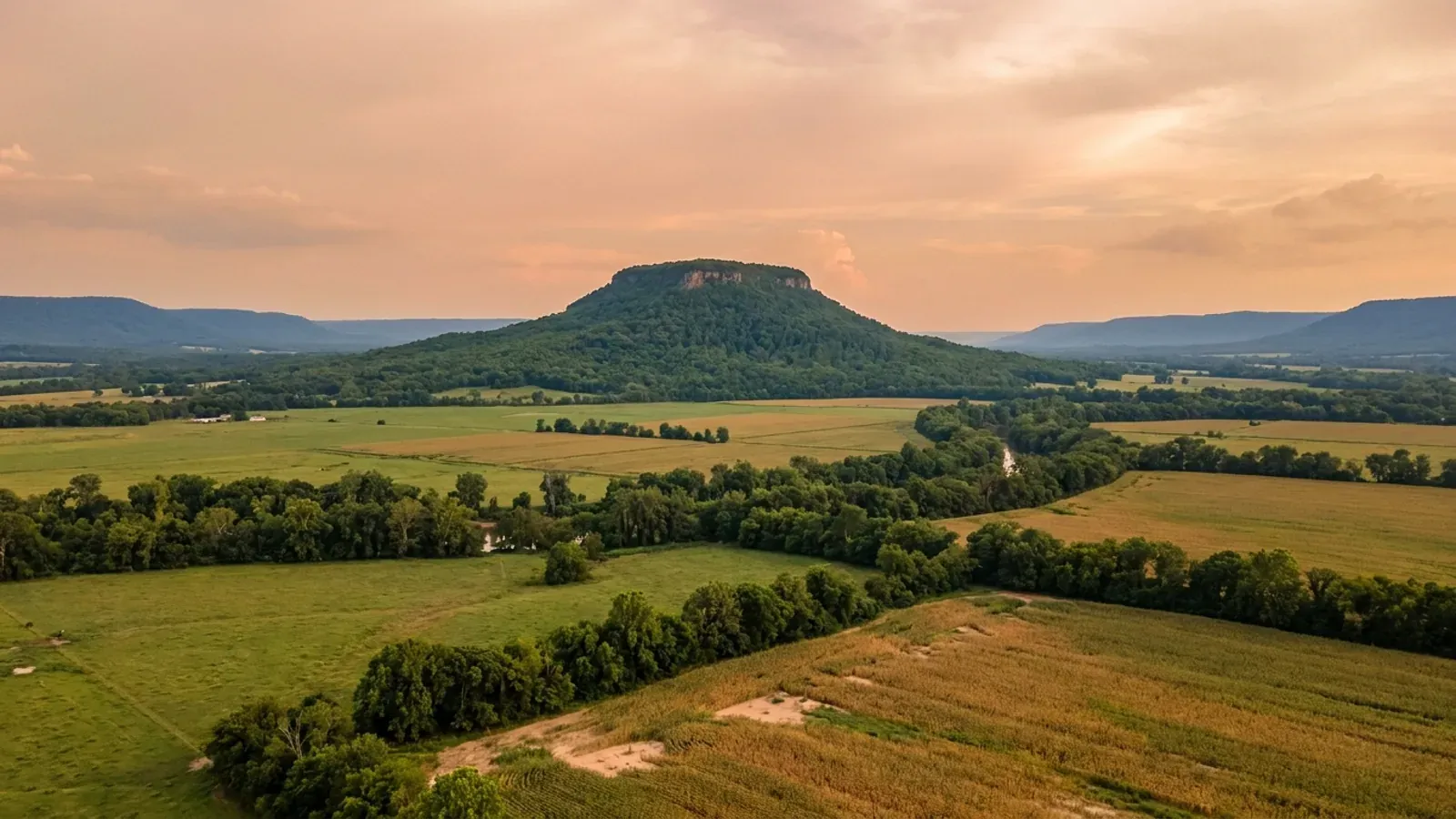
Barndominium Builders in Sebastian County, AR
Sebastian County has two county seats and two courthouses, Fort Smith and Greenwood, written into the Arkansas Constitution itself — and it is the second-smallest county in the state by land, 531 square miles holding 130,641 people. It also has no planning board, no zoning and no county building permit. The county's entire codified building law is one paragraph setting a 25-foot setback from the county road right-of-way. What actually gates a rural build here is not a permit counter but an address, and inside a mapped floodplain, a development permit signed by the County Judge.
Sebastian County at a glance
- County
- Sebastian County
- Population
- 130,641
- ZIP codes
- 72901, 72903, 72904, 72908, 72916, 72923, 72936, 72937, 72938, 72940, 72941, 72944, 72945
- Site visits
- Sebastian County is compact enough that a site walk anywhere in it — the Fort Smith edge, the Greenwood side, or the Poteau Mountain foot down by Hartford — is a single trip, and it falls inside our regular Arkansas River Valley coverage.
Building conditions in Sebastian County
The State's code reaches every parcel in Arkansas, including rural and unincorporated land. What is not everywhere is the office that checks it: a city or county is authorised to set up a building department, not required to, and a great deal of rural Arkansas never has. So the first question on any parcel is not what the code says — that part travels — but whether anyone here issues a permit, inspects the work, or publishes the design criteria your drawings still have to satisfy. Where nobody does, the obligation does not go away. It just moves to the appraiser, the insurer, your lender and whoever buys the place from you.
https://www.garlandcounty.org/DocumentCenter/View/197/Arkansas-Constitution-1874-PDF
https://www.sebastiancountyar.gov/Departments/County-Clerk/Instrument-Recording-Guidelines
https://codelibrary.amlegal.com/codes/sebastiancounty/latest/sebastianco_ar/0-0-0-1595
https://codelibrary.amlegal.com/codes/sebastiancounty/latest/sebastianco_ar/0-0-0-1147
Also worth knowing before you build in Sebastian County
- The County Judge is personally the Floodplain Administrator
- Sebastian County Code § 151.10 states that 'The County Judge of Sebastian County, or his or her designee, is hereby appointed the Floodplain Administrator.' Chapter 151 was adopted by Ordinance 2023-27 on 21 November 2023 and amended by Ordinance 2023-32 on 19 December 2023 and Ordinance 2024-11 on 18 June 2024. Under § 151.11 the Administrator must obtain accreditation each year through the state coordinating agency, the Arkansas Natural Resources Commission, as required by A.C.A. § 14-268-106. Under § 151.12 a floodplain development permit is required for structural development, clearing, grading, mining, drilling, dredging, placement of fill, excavating, watercourse alteration, drainage improvements, roadway or bridge construction and individual water or sewer installations in a special flood hazard area. It is the only development permit the county issues.
- A realtor sits on the county's floodplain appeal board
- Sebastian County Code § 151.15(A): within Sebastian County the County Judge, the County Assessor and a member from the Board of Directors of the Western River Valley Board of Realtors are the designated Appeal Board. The board hears only allegations of an error in a requirement, decision or determination made by the Floodplain Administrator, and § 151.15(D) states its decisions bind only that code and have no bearing on whether a lending institution requires flood insurance or on what that insurance costs. A three-person board with one seat reserved for a trade association is not a structure most counties use, and it exists because there is no planning board, no board of adjustment and no building board of appeals to hand the job to.
- One foot of freeboard — and in Zone A you have to find the base flood elevation yourself
- Under § 151.21, for a new residential structure in an AE or A1-30 risk zone the top surface of the lowest floor must sit one foot above the published base flood elevation, documented on an elevation certificate completed by an engineer, surveyor or architect licensed in Arkansas. In an A risk zone — a special flood hazard area where no base flood elevation has been determined — the applicant or the applicant's agent must establish a base flood elevation before construction, by a source or method the Floodplain Administrator approves, including the FEMA base level engineering viewer, and then build one foot above it. For the floodway the code fixes the designated height at one foot and imposes severe restrictions or prohibitions on development inside it.
- Thirty-one county offices, and not one of them is a building department
- The Sebastian County department listing runs from Assessor and Circuit Clerk through Cooperative Extension Services, Emergency Management, Financial Management, Maintenance, Parks, Purchasing, Quorum Court, Roads, Technology Services and Veteran's Service to the Treasurer and Collector — 31 entries, including the Greenwood District Court as a department in its own right. There is no planning office, no zoning office, no building department, no permits counter and no code enforcement office anywhere in it. The Circuit Clerk's page describes an office supporting seven circuit judges 'for the operation of the circuit courts in Fort Smith and Greenwood' — one clerk, one docket, two buildings.
- What the second courthouse actually divides is court records, not permits
- The Greenwood District Court's own page states that it 'maintains all Court records for Sebastian County, excluding City of Fort Smith, City of Barling, and Central City', and describes itself as a limited jurisdiction court processing criminal, traffic, civil and small claims cases. That is the real dividing line between the two seats, and it runs through the district courts rather than through land regulation. The circuit courts sit in both Fort Smith and Greenwood under one Circuit Clerk; the County Clerk, the Assessor and the Collector keep staffed counters in both courthouses; and there is one County Judge and one Quorum Court for the whole county.
- In Greenwood you need a permit to replace a water heater; outside the city you need none to build a house
- The City of Greenwood's Planning and Development department publishes its permit list, and it includes additions and remodelling, construction of residential structures, electrical, plumbing and mechanical installation and replacement, excavations within the city limits, storage buildings and accessory structures, storm shelters, swimming pools, underground yard sprinklers and spigots, new fences and fence repairs, water heater replacement, and all activity inside the FEMA special flood hazard area. The department names its adopted codes with effective dates — the 2021 Arkansas Residential Code effective 1 January 2023, the 2021 Arkansas Building and Fire Codes the same day, the 2021 Arkansas Mechanical Code from 1 July 2022, the 2018 Arkansas Plumbing and Fuel Gas Codes from 1 September 2021 and the 2014 Arkansas Energy Code from 1 January 2015 — and adds that 'At this time there are no City of Greenwood amendments to any of the above listed codes.' Cross the city limit and none of it applies.
- Fort Smith's unincorporated islands lost their zoning in 2025
- Act 314 of 2025 abolished municipal extraterritorial jurisdiction in Arkansas, and Fort Smith is one of the places where that had teeth. Maggie Rice, Fort Smith deputy city administrator for planning and special projects, said the law effectively abolishes the city's ETJ: 'The city no longer provides any land use control, subdivision regulations, or future planning within our growth area.' She noted that Fort Smith is unusual in having several unincorporated islands surrounded by city limits, and that 'These islands no longer have any zoning control.' Previous ETJ zoning and land use decisions by the Planning Commission and Board of Directors are nullified, and no annexation efforts were under consideration. The land in that former ring reverted to a county with no planning board.
- The county has been in the flood insurance programme since 1988 and only wrote its flood code in 2023
- FEMA's Community Status Book lists unincorporated Sebastian County as NFIP community 050462, with an initial flood hazard boundary map dated 31 May 1977, an initial FIRM dated 1 April 1988, regular programme entry on the same date, and a current effective map dated 2 March 2012 — the same effective map date carried by the City of Fort Smith, community 055013. Greenwood is community 050198 on a 20 May 2010 map, and the county's other participating communities are Barling 050305, Bonanza 050392, Central City 050601, Hackett 050199, Hartford 050200, Lavaca 050201, Mansfield 050202 (listed across Sebastian and Scott counties) and Midland 050203. The county's current flood damage prevention chapter, by contrast, dates only from November 2023.
- Three of Arkansas's eight western coal fields are in this county, and they are under the buildable half of it
- The Arkansas Geological Survey's table of commercially produced coal by district names eight fields in the West District, south of the Arkansas River, and three of them are in Sebastian County: Bonanza–Jenny Lind, Excelsior–Greenwood and Hartford–Huntington, all producing from the Lower Hartshorne bed. AGS states that the Lower Hartshorne is the most extensive and productive coalbed in Arkansas and that 'In Sebastian County, it is up to 8 feet thick locally', that commercial coal mining in Arkansas has been limited to Johnson, Sebastian, Logan, Franklin, Pope and Scott Counties, and that for many years most of that coal came from underground mines. AGS's own geohazards page lists underground mine collapse alongside sinkholes and earthquakes as a cause of rapid land subsidence. That is a title-and-survey question worth asking in the southern half of this county and almost nowhere else in Arkansas.
- Sebastian County is fourth in Arkansas for fragipan, and it is not a Delta county
- SSURGO's Sebastian County survey area (AR131, data version 10 September 2025) is dominated by three soils: Leadvale at roughly 74,100 acres, Mountainburg at roughly 73,300 and Enders at roughly 59,600, with Taft at about 25,100 and Cane at about 17,300 behind them. Leadvale carries a fragipan from about 64 centimetres down to 130, Taft from 58 to about 150 and Cane from 64 to 183 — a root- and water-restricting pan under something close to a third of the county, which puts Sebastian fourth in Arkansas for fragipan extent at 37.5% of the survey area, behind only Benton, Ashley and Lee. Mountainburg is the opposite problem: lithic sandstone bedrock at 41 to 46 centimetres, roughly sixteen to eighteen inches down. Enders runs 47 to 50 percent clay from about 18 centimetres to weathered shale at 122, with linear extensibility as high as 7.5.
- Two of every five Sebastian County farms are under 50 acres, and 95% of the money is livestock
- The 2022 Census of Agriculture county profile records 628 farms in Sebastian County on 114,180 acres — about a third of the county's land — with an average farm of 182 acres and, by the statewide operations table, a median of 67. By size, 54 operations are 1 to 9 acres, 215 are 10 to 49, 196 are 50 to 179, 110 are 180 to 499 and 53 are 500 acres or more; that puts 43% of the county's farms under 50 acres. Land in farms breaks down as 48,458 acres of pastureland, 37,024 of cropland, 21,887 of woodland and 6,811 other. Livestock, poultry and products account for 95% of the county's $135.4 million of agricultural sales, and crops for 5%. This is small-tract, pasture-and-poultry country, not row-crop country, and that is why homesite-sized parcels exist here.
https://codelibrary.amlegal.com/codes/sebastiancounty/latest/sebastianco_ar/0-0-0-7915
https://codelibrary.amlegal.com/codes/sebastiancounty/latest/sebastianco_ar/0-0-0-7915
https://codelibrary.amlegal.com/codes/sebastiancounty/latest/sebastianco_ar/0-0-0-7987
https://www.sebastiancountyar.gov/Courts/Greenwood-District-Court
https://www.greenwoodar.org/Government/Departments/Planning-Development
https://talkbusiness.net/2025/03/new-state-law-ends-some-fort-smith-land-use-rules/
https://www.geology.arkansas.gov/energy/coal-in-arkansas.html
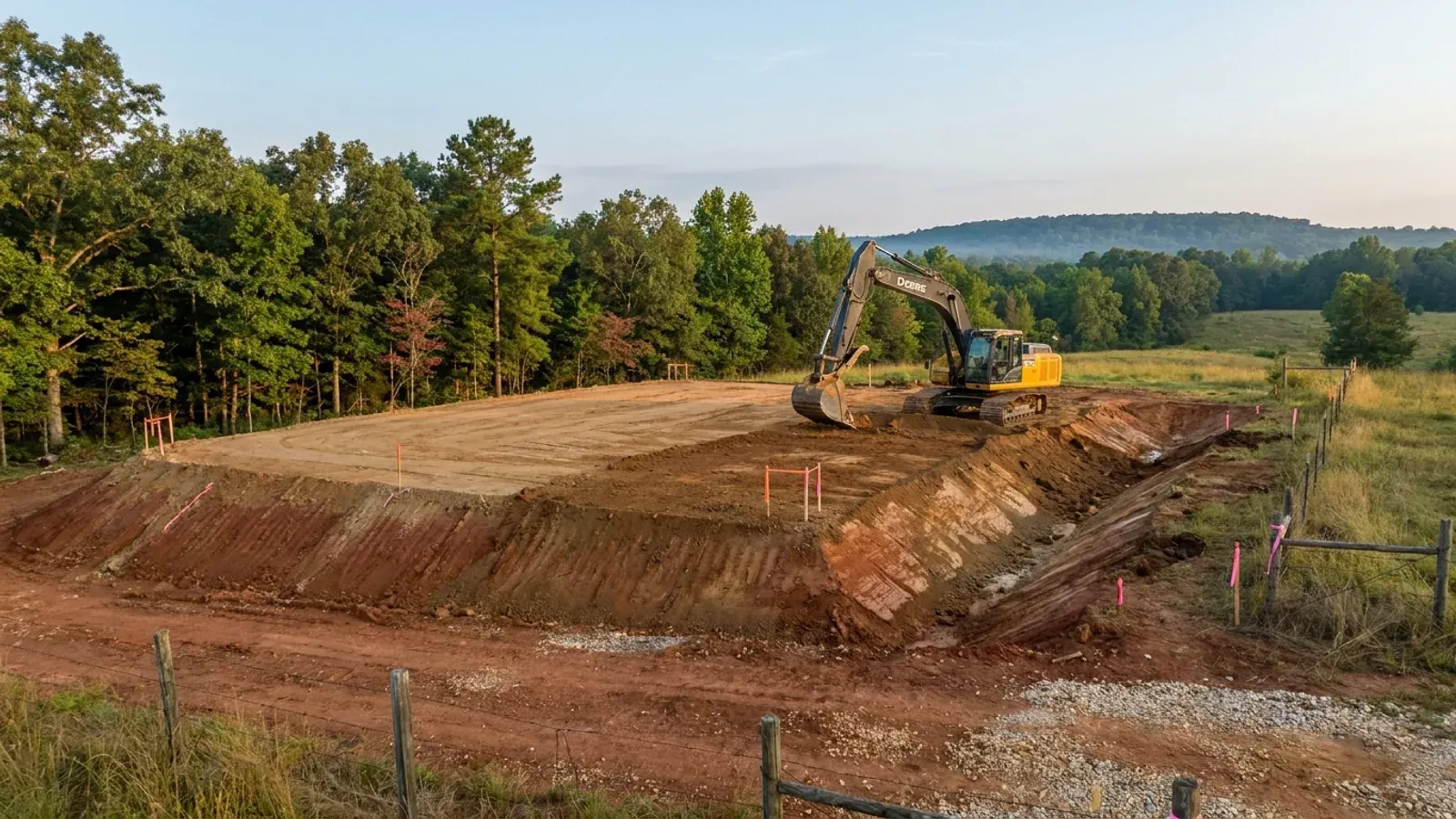
The expensive surprises are in the ground, not the building
What moves an Arkansas budget is usually below grade, and the state hands you a different problem depending on where you stand. In the Delta the issue is shrink-swell clay that moves with the season, and it is the reason a wide, light building with a big slab and a big door opening is the shape most at risk. Along the Fall Line there is a second, separate clay belt with nothing to do with the Delta at all. Up in the Ozarks the question inverts: what matters is not what the slab sits in but what is under it, because that limestone is full of solution cavities and the collapses arrive with no prior indication at the surface. And on Crowley's Ridge, where Jonesboro and Paragould sit, it is fine wind-blown loess that stands up in a vertical cut and then erodes out from under whatever you put on it. The same ground decides your wastewater system, which is the gate that most often moves a rural build's schedule — and it is soils that decide it, not the size of the house. So the site work, the foundation and the wastewater get resolved together rather than one at a time. We price the dirt before we price the building.
What we build in Sebastian County
All nine services are available in Sebastian County. What a build costs depends far more on the parcel than on square footage, so we price against your land rather than publishing a rate card.
Custom Barndominium Plans
Barndominium floor plans, elevations and engineered documents drawn to your parcel — and to the design numbers your Arkansas jurisdiction publishes.
Barndominium Kits
Engineered barndominium shell packages for Arkansas land, drawn to a named jurisdiction's criteria rather than to a national vendor's generic spec.
Turnkey Barndominium Builds
Land through handover under one contract, and a straight answer on what actually gates a barndominium build on rural Arkansas land.
What a build looks like
Three stages every Sebastian County project passes through, from a raw parcel to a finished home. Site work first, because that is where the budget is decided.
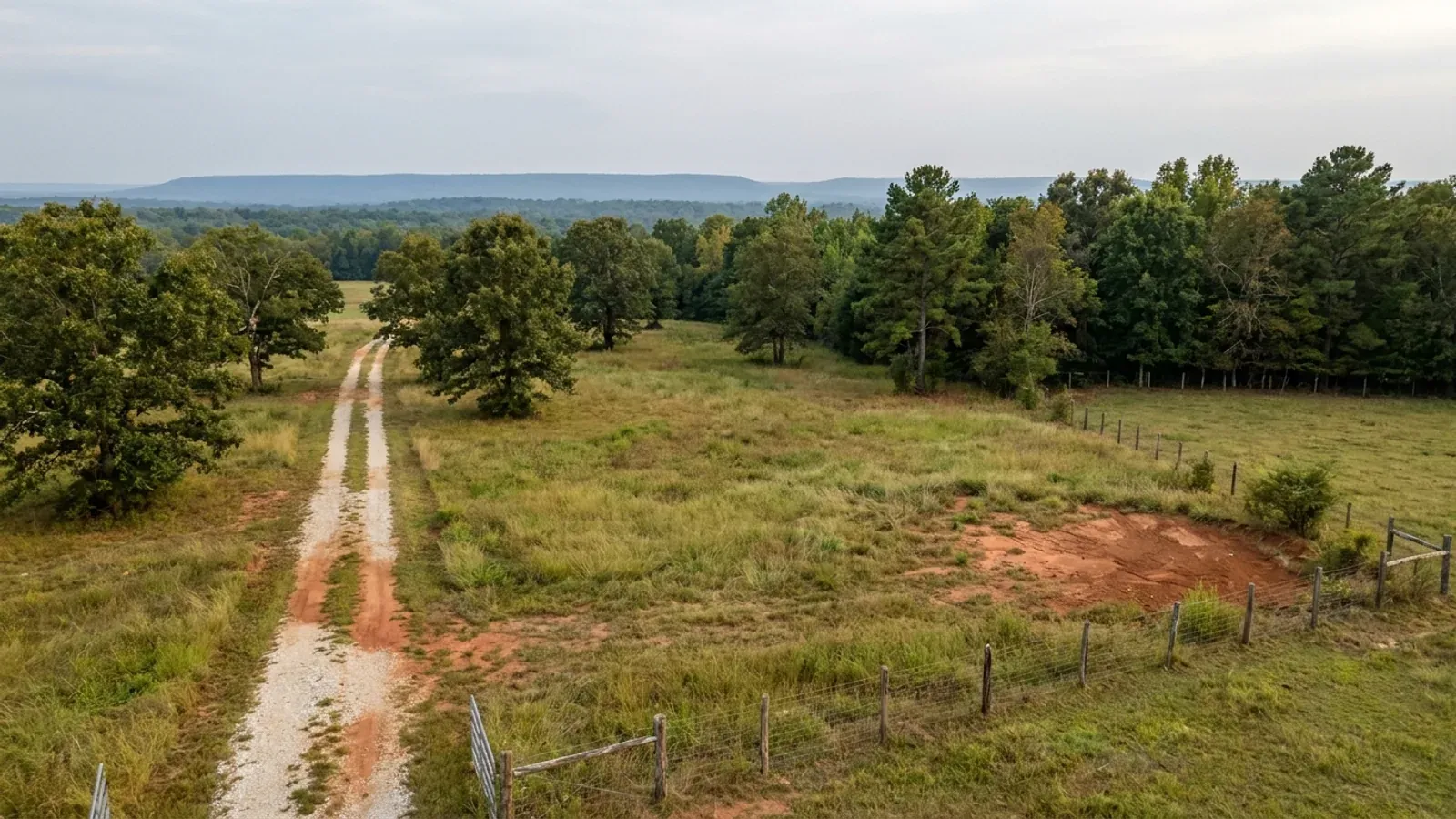
The parcel
Zoning, setbacks, flood zone and utility access get checked before anything is drawn.
Pad and permit
Clearing, grading and a compacted pad, while the submittal works through whichever office issues the permit where you are building.
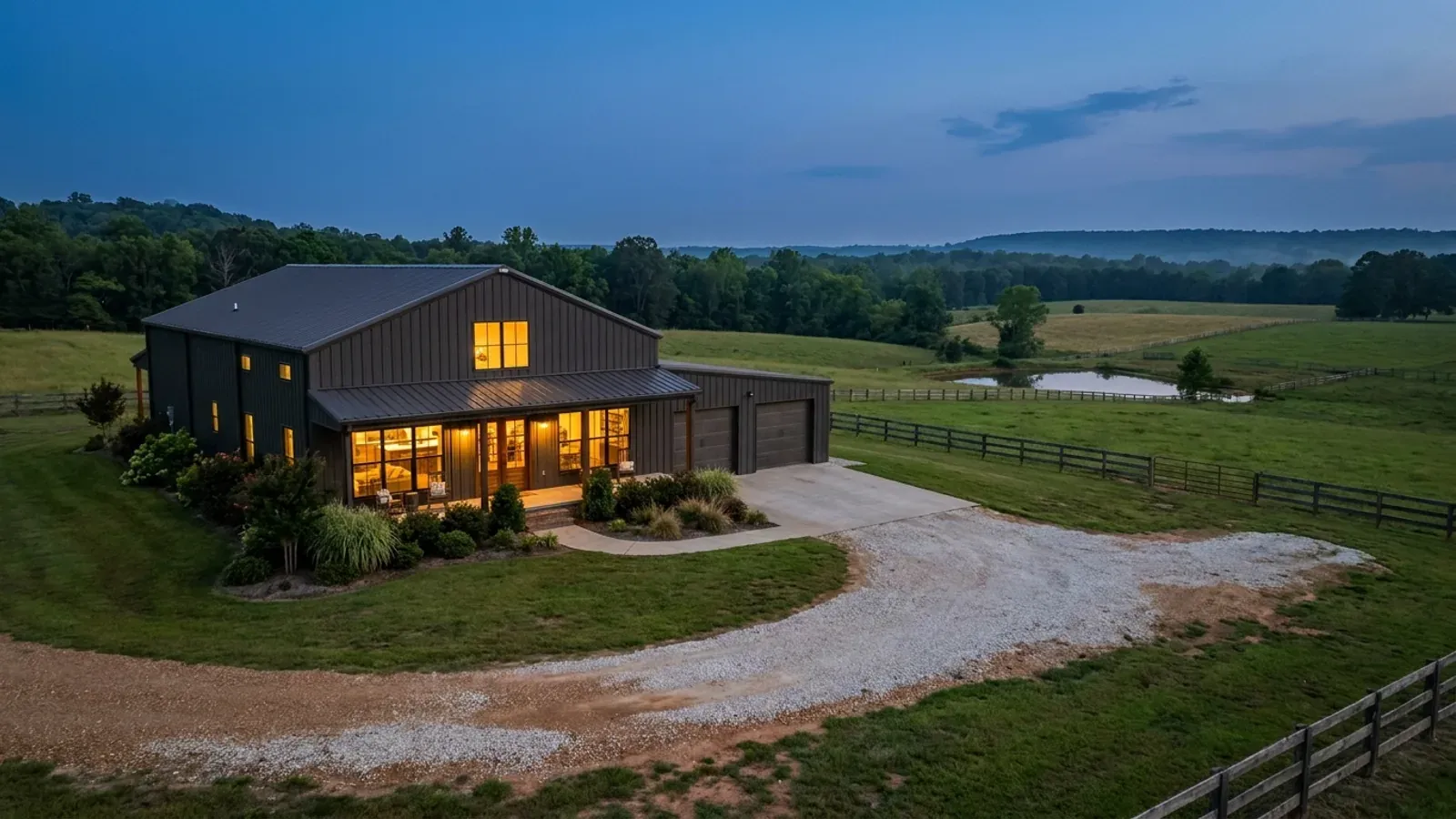
Frame to finish
Shell erected and dried in, then systems, insulation and interior finish through to CO.
Those are the rules where you are building in Sebastian County. Tell us what you want to build and we will draw it to them.
Where we build around Sebastian County
Sebastian County and the rural land around it. The buildable acreage for a project this size usually sits outside the city limits, which is frequently what changes who issues your permit.
Keep reading
The questions that usually come next once you know what Sebastian County allows.
Barndominium Cost Guide
Sourced per-square-foot ranges by tier and by size, with a calculator built on the same figures.
Read itThe Arkansas Building Code
The code applies statewide, including unincorporated land — but a jurisdiction is only authorized to establish a building department, so on rural residential land there is often no counter at all.
Read itBuying Land in Arkansas
Where acreage is actually purchasable in homesite sizes, and what percolation, slope and the onsite wastewater rule do to a parcel before anything is designed.
Read itNearby areas we build in
Others we cover nearby. One may be a county, another a city inside it — and since March 2025 the soft edge between them is gone, because the cities' extraterritorial jurisdiction was abolished outright and that land reverted to the counties. So the office that issues the permit, the fees it charges, the zoning and whether anyone publishes design criteria at all can differ from one card to the next, and the boundary that decides it may have moved recently.
Building in Sebastian County: common questions
9 questions we get asked most often about building in Sebastian County. If yours is not on the list, ask it directly.
Sebastian County has two county seats. Does that mean two sets of rules?
Do I need a building permit to build a barndominium in unincorporated Sebastian County?
If there is no permit, what does Sebastian County actually require before I build?
Fort Smith used to regulate land outside its city limits. What happened to that?
What changes if I build inside Greenwood or Fort Smith instead of out in the county?
What design wind speed and snow load should a barndominium here be built to?
Can I actually buy acreage in Sebastian County, or should I look one county over?
What is the ground like here, and what does it do to a foundation?
My neighbour's land is in Oklahoma. Does any of this apply there?
Building in Sebastian County?
Start with the plan. Tell us what you want to build and we will draw it, then confirm which office issues the permit for your parcel, what it will let you put there, and what wind load it has to meet. That conversation costs nothing.