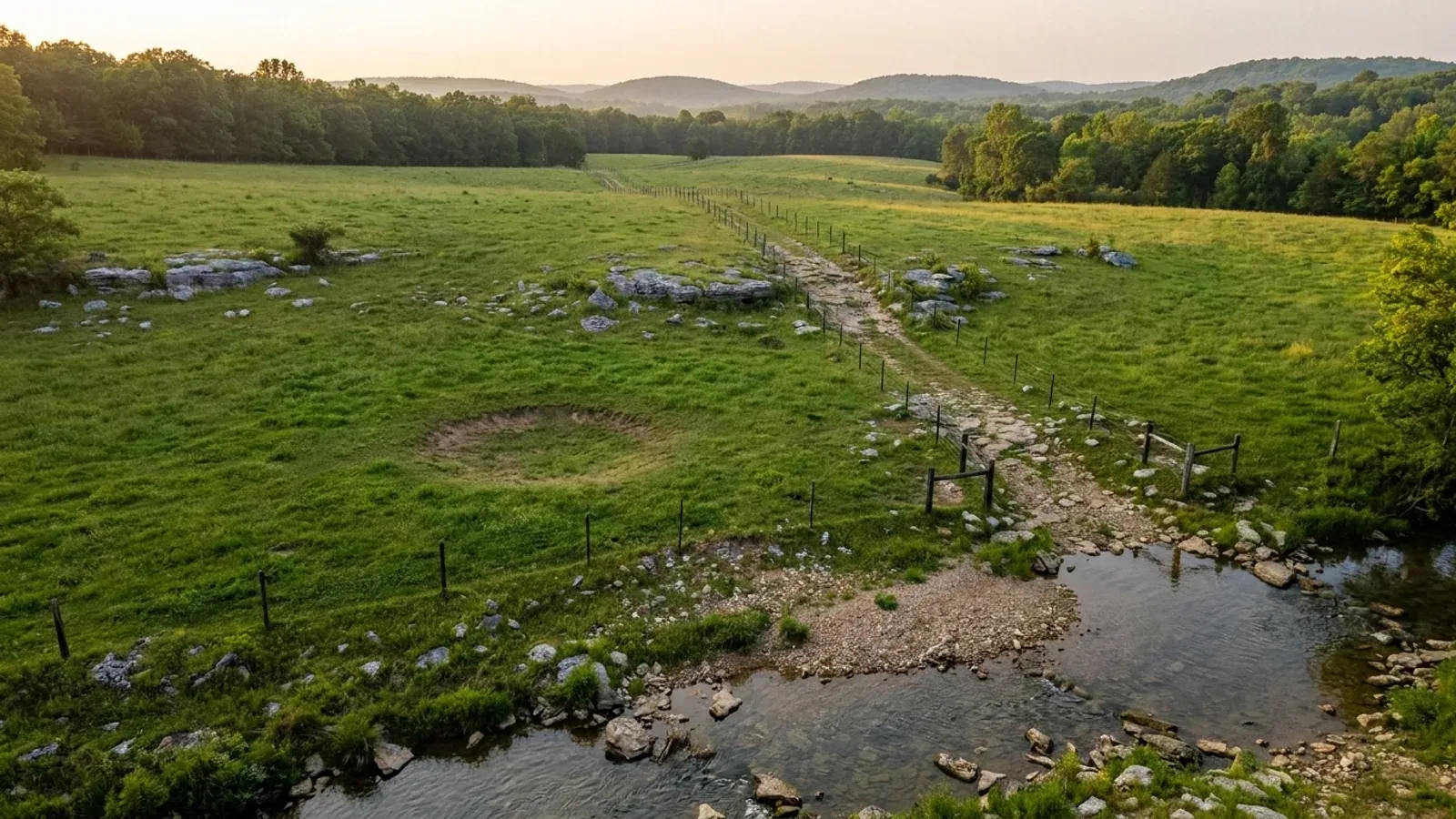
Rolling Ozark upland pasture with limestone ledges, a chert gravel track and a clear spring-fed creek.
Benton County Statewide code, local enforcement optional

Barndominium Builders in Benton County, AR

Benton County is the fastest-growing county in Arkansas, up about 17% from the 2020 census to roughly 332,554 people, and it is one of the very few Arkansas counties that runs a real building department outside its cities. The county adopted the 2021 Arkansas Fire Prevention Code by ordinance, permits and inspects residential construction in the unincorporated county, prints its own fee schedule, and has a checkbox on its permit application that says Barndominium. What it has never adopted is zoning. The harder fact is the land: farm ground here carries the highest per-acre value in the state, which is why the buyer who wants real acreage keeps ending up east in Madison County or north-east in Carroll.

Benton County at a glance

County
Benton County
Population
332,554
ZIP codes
72712, 72713, 72714, 72715, 72718, 72719, 72722, 72732, 72734, 72736, 72739, 72745, 72751, 72756, 72758, 72761, 72768
Site visits
Unincorporated Benton County sits inside our regular Northwest Arkansas coverage, so site walks, karst and soil questions and trips to the Building Safety counter in Bentonville are routine here rather than special arrangements.

Building conditions in Benton County

The State's code reaches every parcel in Arkansas, including rural and unincorporated land. What is not everywhere is the office that checks it: a city or county is authorised to set up a building department, not required to, and a great deal of rural Arkansas never has. So the first question on any parcel is not what the code says — that part travels — but whether anyone here issues a permit, inspects the work, or publishes the design criteria your drawings still have to satisfy. Where nobody does, the obligation does not go away. It just moves to the appraiser, the insurer, your lender and whoever buys the place from you.

Build conditions for Benton County , Arkansas . BUILD CONDITIONS BENTON COUNTY, ARBenton CountyONE STATEWIDE CODEADOPTED RESIDENTIAL CODEONE STATEWIDE CODEThis jurisdiction publishes no design wind speed. It is settled in writing with the authority overyour parcel before the frame is ordered.ZONING · NONE - BENTON COUNTY HAS ADOPTED NO…1 acreThe county's own Planning Department states that Benton County doesnot have zoning in the unincorporated areas, that it does enforce…BENTON COUNTY PLANNING STORMWATER AND FLOODPL…$50.00 for one acre or less; $100.00…Section 54-5 of the Benton County Code of Ordinances prices thePlanning Department's permits separately from the Building Safety…WHO ISSUES THE PERMITBenton County Building Safety Depart…215 E Central Ave, Bentonville, open 8 a.m. to 4:30 p.m. throughlunch; phone 479-271-1003, text 475-522-1003,…
Build conditions for Benton County, drawn from the sourced facts on this page. Every figure above is cited in the quick-facts panel below, with its source and vintage.
Benton County's permit application has a checkbox that says Barndominium
On the Benton County Building Safety residential application, the Building Information block lists five project types and the second one is 'Barndominium/Shouse', alongside New Home, Accessory Building with H/C Living Space, Addition and Remodel. The same sheet asks you to circle an exterior framing type from Wood (poles, 2x4 or 2x6), Metal (pre-engineered) or Concrete (ICF), and a foundation type from Stem Wall, Block (CMU), Monolithic slab, Piers or Post frame. The county's guidebook repeats it in prose: for new dwellings, additions, remodels and Barndominiums/Shop Houses you use the Residential Permit application. Very few building departments anywhere name the building type on the form. This one names the framing system too.

https://bentoncountyar.gov/building-safety/wp-content/documents/sites/36/2024/06/BSG-Combined-02112025.pdf

The county prints its building permit fee, and it is priced off a valuation table, not off square footage
Benton County Ordinance O-2024-62, adopted 21 November 2024 and sponsored by Justice of the Peace Susan Anglin, sets the residential building permit fee by total cost of construction, with that cost determined from the ICC Building Valuation table dated February 2024 attached to the ordinance as an appendix. The ladder is $25.00 for the first $1,000.00 plus $4.00 per additional thousand up to $50,000.00; then $245.00 for the first $50,000.00 plus $3.00 per thousand to $100,000.00; then $445.00 for the first $100,000.00 plus $2.00 per thousand to $500,000.00; then $1,245.00 for the first $500,000.00 plus $1.00 per thousand. Article 2 adds a $50.00 re-inspection fee, a $50.00 plan review fee for commercial and industrial buildings only, $100.00 for home relocation or prefabricated dwellings, $50.00 trade permit fees and $50.00 demolition. Article 4 repealed the county's 2008 fee ordinance outright. The valuation table's own notes say private garages are valued as Utility, miscellaneous and that shell-only buildings deduct 20 percent.

https://bentoncountyar.gov/building-safety/wp-content/documents/sites/36/2023/10/O-2024-62.pdf

Benton County has a planning board, a building department and no zoning
The county's Planning Department publishes a page headed Benton County Zoning whose first line is that Benton County does not have zoning in the unincorporated areas of the county. It goes on to say the county does enforce subdivision rules and regulations, that commercial and industrial development must be approved by the Planning Board, and that the current regulations do not limit the uses of land, so a property in unincorporated Benton County may generally be developed as the owner desires. The department's FAQ puts the same point positively: all property in the unincorporated areas can be used, by right, for single-family residential and agricultural purposes, with the note that this does not mean permits are not required. Arkansas county zoning is a two-step opt-in under A.C.A. 14-17-203 and 14-17-209. Benton County took the planning-board step and adopted a building code, and stopped short of the zoning step.

https://bentoncountyar.gov/county-planning/zoning/

Benton County farmland is valued at 2.5 times the Arkansas average, and that is the whole problem
The 2022 Census of Agriculture puts the asset value of agricultural land and buildings on Benton County farms at $9,796 per acre, the highest of any Arkansas county, against a state average of $3,921. Neighbouring Carroll County comes in at $3,992 and Madison County at $4,232. Those are producers' self-reported asset values on operating farms rather than asking prices for a homesite tract, so read the ratio and not the dollar: Benton County ground is valued at roughly two and a half times the state figure and about two and a half times its two nearest rural neighbours. The county is not short of small parcels, either. It has 1,796 farms on 216,914 acres, 40% of its land area, with a median farm of 50 acres and about 49% of farms under 50 acres, the finest-grained rural ownership in Arkansas. The land is already cut into homesite-sized pieces. It is priced accordingly.

https://www.nass.usda.gov/Publications/AgCensus/2022/Online_Resources/County_Profiles/Arkansas/cp05007.pdf

Also worth knowing before you build in Benton County

Since November 2023 a detached shop with no living space needs no county building permit
The Building Safety Department's permits page states that effective 28 November 2023, Benton County no longer requires building permits for Group U structures in unincorporated areas, including detached shop buildings with no living space, carports, storage buildings, decks and fences. The exceptions are the whole point for a barndominium buyer: permits are still required for any structure attached to a residence or for commercial use, and still required for new plumbing, electrical or HVAC work. Even where no building permit is needed, the county asks you to contact the Planning Office so it can review your site plan.

https://bentoncountyar.gov/building-safety/permits/

Benton County adopted the state code by its own ordinance, which the State only encourages
Ordinance O-2023-71, adopted 26 October 2023, is titled 'An ordinance adopting the Arkansas Fire Prevention Code, 2021 Edition (three volumes, Fire, Building & Residential) by reference, and repealing the 2012 edition of the same code.' The State Fire Marshal's Office only encourages Arkansas cities and counties to adopt the code as a local ordinance; Benton County did it. The county's Code Information page lists the full enforced set: the 2021 Arkansas Fire Prevention Code Volumes I, II and III, the 2020 National Electric Code, the 2018 Arkansas State Plumbing Code, the 2018 Arkansas State Fuel Gas Code, the 2021 Arkansas State Mechanical Code, the 2014 Arkansas State Energy Code and the 2021 International Pool and Spa Code.

https://bentoncountyar.gov/building-safety/code-information/

The county's farm-building exemption stops at the words 'human habitation'
Chapter IX of the Planning and Development Regulations of Benton County exempts agricultural buildings from the building permit process, inspections and fees. The regulations' own definition then closes the door: an agricultural building is a structure designed and constructed to house farm implements, hay, grain, poultry, livestock or other horticultural products, and 'this structure shall not be a place of human habitation or a place of employment where agricultural products are processed, treated, or packaged, nor shall it be a place used by the public.' The same wording appears in Section 54-4 of the county Code of Ordinances. A pole barn built to store hay is exempt. The same building with a bedroom in it is a dwelling, and it is permitted and inspected like any other house in the county.

https://bentoncountyar.gov/county-planning/wp-content/documents/sites/13/2023/10/2023-Effective-Benton-County-Planning-and-Development-Regulations.pdf

Act 314 handed Benton County the old Centerton, Bentonville and Rogers planning rings
The Northwest Arkansas Democrat-Gazette reported on 2 July 2025, in a photo caption from the future site of Punkin Hollow Estates near Bentonville, that the Centerton Planning Area would fall under Benton County's jurisdiction after Arkansas Act 314 of 2025 took effect on 5 August, Act 314 having repealed a municipality's authority to exercise extraterritorial jurisdiction over an unincorporated area of a county adjacent to but not within the city's boundaries. The same story reported that Benton County planning director Madison Kienzle had asked for a new planning manager position to handle the increased volume and complexity of land subdivision applications expected after 5 August, and that the Quorum Court appropriated the money on 26 June. By 2 January 2026 the paper was reporting that more than a third of the applications the county's Planning Department processed over the previous five months came from areas newly under its jurisdiction.

https://hl.nwaonline.com/news/2025/jul/02/northwest-arkansas-cities-counties-talk/

The county's posted regulations still describe the city planning rings that state law abolished
Section 1.5 of the Planning and Development Regulations of Benton County, the edition the county still posts, sets out a Planning Boundary keyed to A.C.A. 14-56-413 and reprints the old mileage tiers verbatim: one mile for cities of 8,000 to 60,000, two miles for 60,000 to 150,000, three miles for 150,000 and over. Section 1.5(B) then sets a review-coordination procedure under A.C.A. 14-17-208(i), and Section 5.2 exempts from the subdivision rules any land 'located in the Planning Boundary', to be developed to the relevant city's standards instead. Act 314 of 2025 repealed section 14-56-413 in its entirety and repealed 14-17-208(i) as well. The county's Code of Ordinances lists, among the ordinances adopted but not yet codified, Ordinance O-2025-28 of 26 June 2025, adopting Planning and Development Regulations of Benton County by reference - six weeks before the repeal took effect.

https://bentoncountyar.gov/county-planning/wp-content/documents/sites/13/2023/10/2023-Effective-Benton-County-Planning-and-Development-Regulations.pdf

One acre is the floor, 25 acres is the ceiling, and the setbacks run off the road centerline
Section 4.3 of the Planning and Development Regulations requires all individual residential or non-residential lots or parcels in unincorporated Benton County to be a minimum of one acre, with a minimum frontage of 120 feet, dropping to 60 feet on a cul-de-sac turning circle, and lots needing both a septic system and a water well sized to satisfy Arkansas Department of Health requirements. Minimum side and rear setbacks are ten feet. Front setbacks are 65 feet from the centerline of an arterial road, 55 feet from a collector and 50 feet from a local road, or 25 feet from the fronting property line, whichever is greater. At the other end, Section 5.2 exempts from the subdivision rules altogether any division of land in unincorporated Benton County producing parcels of 25 acres or more, and any division for agricultural purposes that involves no new streets or access easements.

https://bentoncountyar.gov/county-planning/wp-content/documents/sites/13/2023/10/2023-Effective-Benton-County-Planning-and-Development-Regulations.pdf

Benton County publishes an 18-inch frost line and will not accept a footing in fill
The county's footing inspection policy is specific in a way almost nothing else in Arkansas is. Footing width and depth must match the approved plans with a minimum 12-inch concrete thickness unless a soil analysis is done; footings must be installed below the frost line, which the policy gives as 18 inches; the inspector checks the soil for loose material, mud, water, organic material and expansive soil; and where footings are excavated into fill dirt the builder must produce a soil compaction report, dig to native soil, or have a structural engineer design the foundation. For a monolithic slab poured in one pour, depth must not be less than 15.5 inches measured from the top of the slab form to the bottom of the footing, and 12-inch-diameter piers to native soil on the corners and every 8 feet on centre are one of the accepted answers to a fill-dirt footing. Stepped footings are required on slopes of 10% or greater.

https://bentoncountyar.gov/building-safety/wp-content/documents/sites/36/2023/10/Inspection-Policies-013025.pdf

Benton County holds more mapped sinkholes than any other county in Arkansas
The U.S. Geological Survey digitised springs and sinkholes across the Arkansas Ozarks from more than 200 topographic quadrangle maps published between 1942 and 2014, drawn from 22 different counties, producing 805 springs and 1,242 sinkholes. Benton County accounts for 332 of those 1,242 sinkholes, more than any other county in the state and more than a quarter of the statewide total on its own; with Washington County's 165 the two Northwest Arkansas growth counties hold about 40% of every sinkhole the survey mapped. The reason is the bedrock: the Springfield Plateau surface is underlain by limestone of the Boone Formation, which the Arkansas Geological Survey says contains the majority of karst features in the Ozark Plateaus region and more than half the caves in the state. These are mapped sinkholes, not a risk map, and a depression that opened after the quad sheet was drawn is not in the count.

https://www.sciencebase.gov/catalog/item/5728fd08e4b0b13d3918aa35

Shallow bedrock under 5.7% of the county, and that is exactly why the sinkholes are dangerous
SSURGO records a bedrock restriction within 152 cm under only about 5.7% of the Benton County survey area, one of the lowest shares of any Ozark county and far below neighbouring Washington at 35.3%, Madison at 43.1% and Carroll at 43.0%. That is not a sign of an absence of karst; it is the mechanism. The Boone Formation limestone here weathers to a deep cherty residuum, and the Arkansas Geological Survey's own account of land subsidence is that in most of north Arkansas the carbonate bedrock is covered by a variable thickness of clay, silt and sand, that a thicker clay-rich overburden may bridge subsurface cavities for long periods, and that a cover-collapse sinkhole usually develops in a short period of time with no prior indication of its pending existence. The survey adds that sudden failures have occurred especially during extreme swings of groundwater level between prolonged wet and dry periods.

https://geology.arkansas.gov/geohazards/land-subsidence.html
Two chert soils cover 45% of the county, and two fifths of it sits on a fragipan
SSURGO's two most extensive soils in the Benton County survey area are Clarksville at roughly 132,500 acres and Nixa at roughly 112,600 acres, about 45% of the county between them. Clarksville is a somewhat excessively drained loamy-skeletal Typic Paleudult formed in hillslope sediments over clayey residuum from cherty dolomite or limestone, mapped on slopes from 1 to 70 percent, with bedrock deeper than 80 inches. Nixa is a Glossic Fragiudult whose typical pedon runs about 40% chert by volume at the surface and 70 to 80% chert lower down, and whose fragipan sits 14 to 27 inches down; its permeability is described as very slow. Captina, the county's third soil at about 48,900 acres, is a Typic Fragiudult with its pan 16 to 38 inches down. Statewide SSURGO puts a fragipan under 40.2% of Benton County, the highest share of any county in Arkansas. A fragipan perches water above itself through winter and spring and is a restrictive layer for septic purposes, and in Nixa soil its upper surface can sit at almost exactly the county's 18-inch footing depth.

https://soilseries.sc.egov.usda.gov/OSD_Docs/N/NIXA.html

Four phone calls have to happen before Benton County will take the application
The county guidebook sets out a pre-completeness check with four steps and four different agencies: contact the Arkansas Department of Health to begin septic approval, on 479-986-1300; verify a valid project address with 911 Administration on 479-271-1085; obtain a driveway permit from the Benton County Road Department if you are connecting a new entrance to a county road, on 479-271-1052; and contact the Benton County Planning Department on 479-464-6166, which verifies compliance for stormwater, flood and density. Only then does Building Safety take the residential application, which must arrive with the septic approval, the site plan approval, the contractor licence and building plans, on paper no larger than 11x17 or submitted digitally. A septic approval older than one year on the date in box 21 has expired and must be revalidated.

https://bentoncountyar.gov/building-safety/wp-content/documents/sites/36/2024/06/BSG-Combined-02112025.pdf

Benton County does not inspect the trades on a long list of named utility systems
The residential application carries two lines that catch people out. For water, Benton County does not inspect BCWD#1, Cave Springs, Garfield, Gateway, Gentry, Lost Bridge Village, Lincoln, Madison County, Pea Ridge, Siloam Springs, Springdale or Washington County water utility providers, and the guidebook says the same for gas; on those systems you obtain plumbing and gas permits and inspections from the provider and send the inspection reports to the county before the slab, framing and final inspections. For electric, the county does not inspect Siloam Springs, so you take the electrical permit and inspections to the City of Siloam Springs and send the reports before framing and final. On a large rural county with a dozen water districts, the utility on your parcel decides who inspects your pipe.

https://bentoncountyar.gov/building-safety/wp-content/documents/sites/36/2024/06/BSG-Combined-02112025.pdf

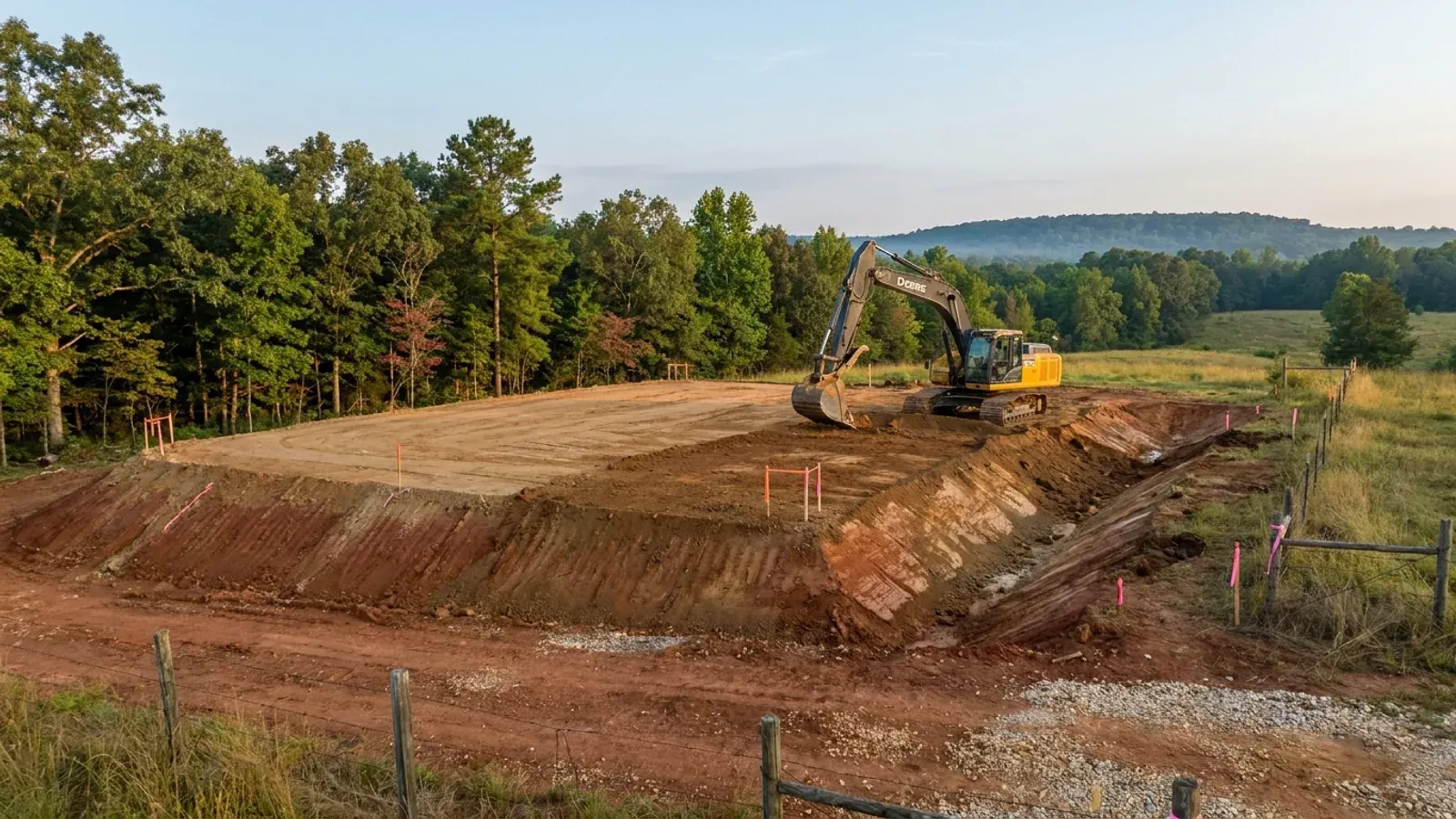
An excavator grading a compacted building pad on a cleared lot, with survey stakes and a drainage swale visible.
Below the slab

The expensive surprises are in the ground, not the building

What moves an Arkansas budget is usually below grade, and the state hands you a different problem depending on where you stand. In the Delta the issue is shrink-swell clay that moves with the season, and it is the reason a wide, light building with a big slab and a big door opening is the shape most at risk. Along the Fall Line there is a second, separate clay belt with nothing to do with the Delta at all. Up in the Ozarks the question inverts: what matters is not what the slab sits in but what is under it, because that limestone is full of solution cavities and the collapses arrive with no prior indication at the surface. And on Crowley's Ridge, where Jonesboro and Paragould sit, it is fine wind-blown loess that stands up in a vertical cut and then erodes out from under whatever you put on it. The same ground decides your wastewater system, which is the gate that most often moves a rural build's schedule — and it is soils that decide it, not the size of the house. So the site work, the foundation and the wastewater get resolved together rather than one at a time. We price the dirt before we price the building.

What a build looks like

Three stages every Benton County project passes through, from a raw parcel to a finished home. Site work first, because that is where the budget is decided.
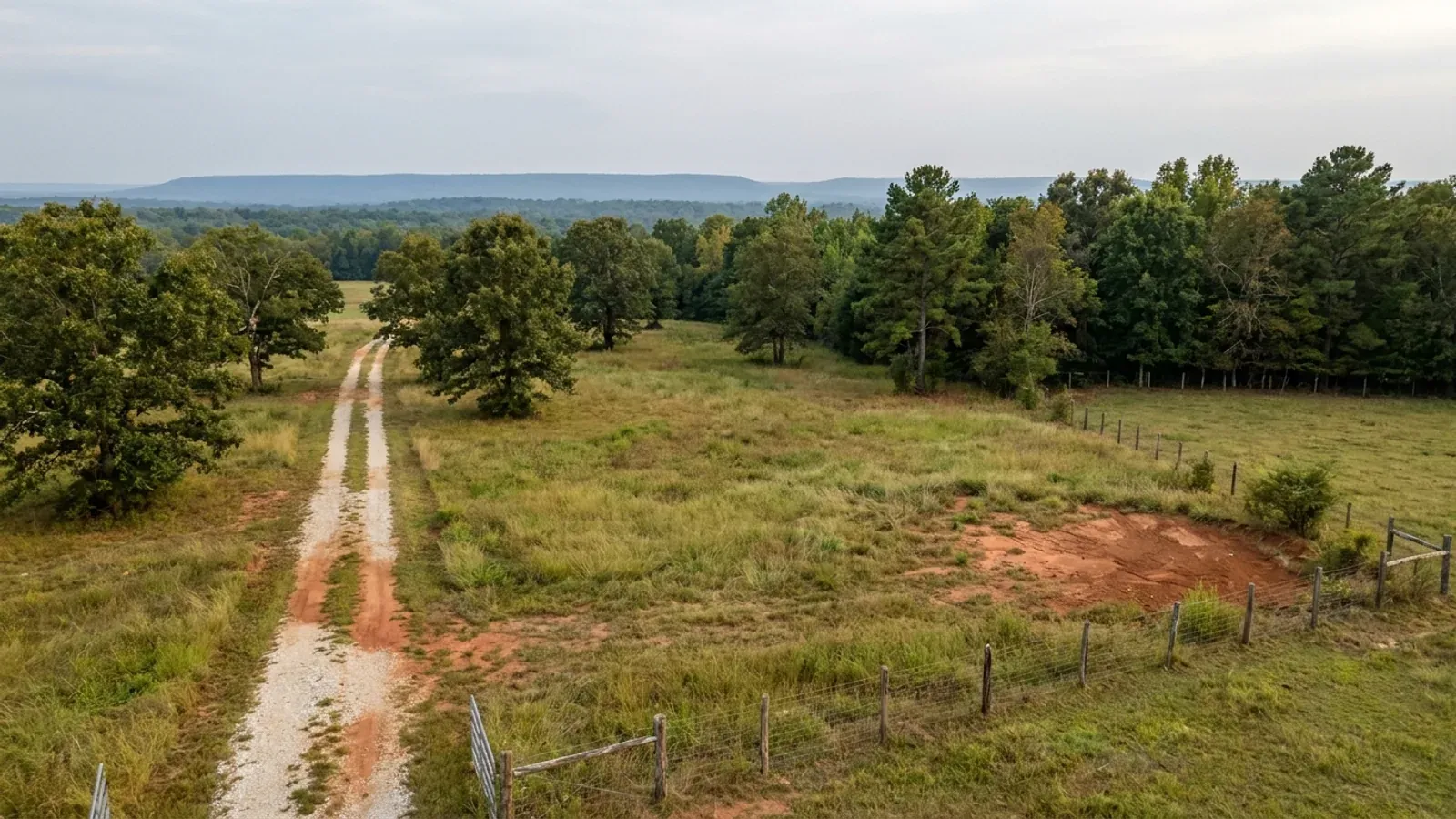
Aerial view of an undeveloped rural lot with cleared grass, an oak and hickory treeline with shortleaf pines, and a pale gravel access track.
Stage one

The parcel

Zoning, setbacks, flood zone and utility access get checked before anything is drawn.

An excavator grading a compacted building pad on a cleared lot, with survey stakes and a drainage swale visible.
Stage two

Pad and permit

Clearing, grading and a compacted pad, while the submittal works through whichever office issues the permit where you are building.
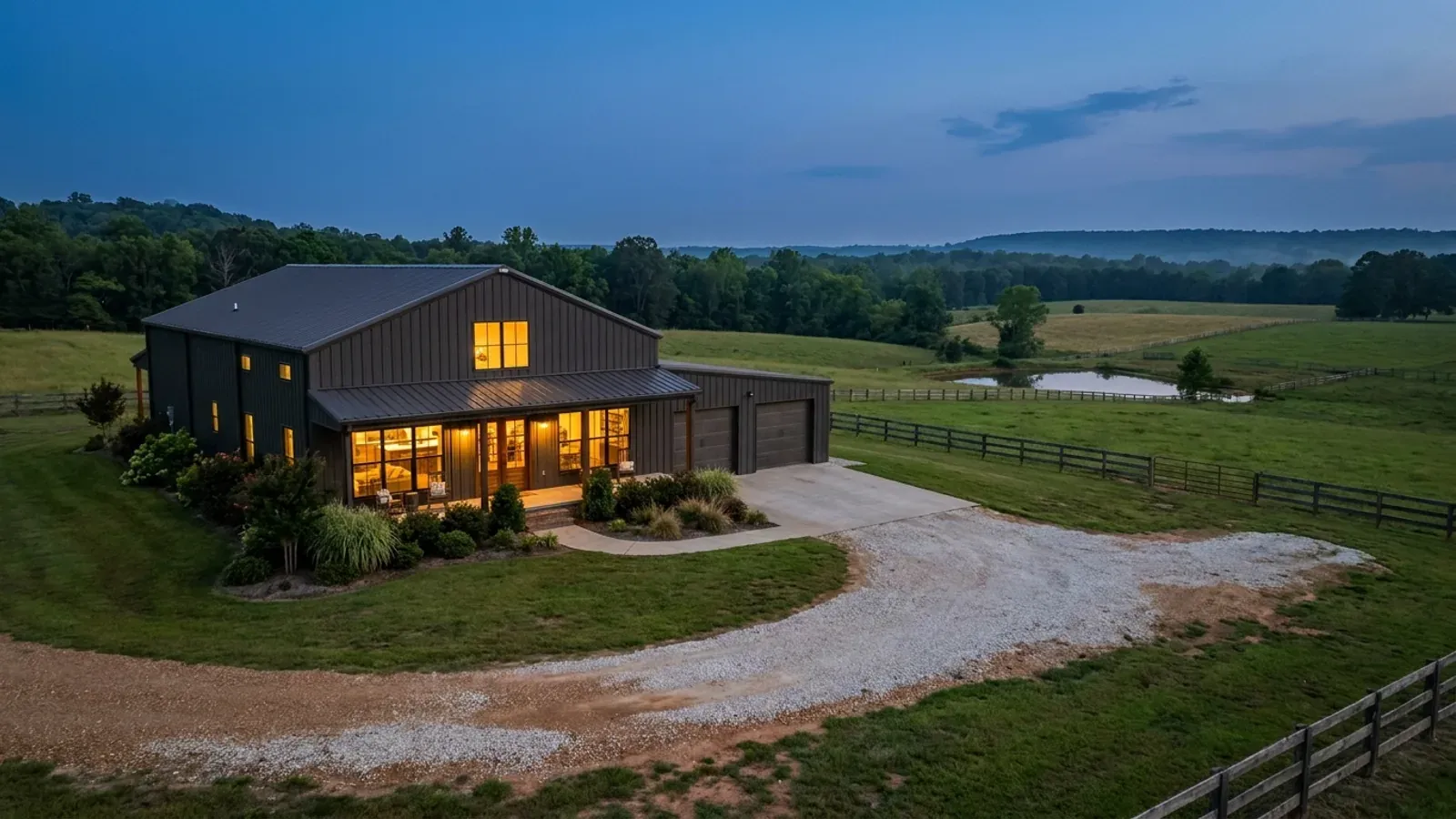
A finished barndominium at dusk with warm interior lighting glowing through its large windows.
Stage three

Frame to finish

Shell erected and dried in, then systems, insulation and interior finish through to CO.

Those are the rules where you are building in Benton County. Tell us what you want to build and we will draw it to them.

Where we build around Benton County

Benton County and the rural land around it. The buildable acreage for a project this size usually sits outside the city limits, which is frequently what changes who issues your permit.

The Benton County service area, including the rural acreage outside the built-up edge, which is where the parcels big enough for a build like this usually sit. The map marks the territory we build in. It is not a branch location, and there is no office at this pin.

Nearby areas we build in

Others we cover nearby. One may be a county, another a city inside it — and since March 2025 the soft edge between them is gone, because the cities' extraterritorial jurisdiction was abolished outright and that land reverted to the counties. So the office that issues the permit, the fees it charges, the zoning and whether anyone publishes design criteria at all can differ from one card to the next, and the boundary that decides it may have moved recently.

Building in Benton County: common questions

9 questions we get asked most often about building in Benton County. If yours is not on the list, ask it directly.

Do I need a building permit to build a barndominium in unincorporated Benton County?
Yes, and Benton County is one of the few Arkansas counties where the answer is that simple. The Benton County Building Safety Department at 215 E Central Ave in Bentonville requires a building permit for new construction, additions and interior remodels of single-family homes in the unincorporated county, and its residential application has a project-type checkbox that reads Barndominium/Shouse. The guidebook says the same in prose: for new dwellings, additions, remodels and Barndominiums/Shop Houses, you use the Residential Permit application. Before the county will take that application, four other things have to be in hand. The Arkansas Department of Health's Benton County unit in Rogers has to have issued a septic approval, and if the approval date is more than a year old it has expired and must be revalidated. 911 Administration has to have assigned a project address. The Road Department has to have issued a driveway permit if you are making a new connection to a county-maintained road. And the Planning Department has to have checked the site plan for stormwater, flood and density. The application itself wants a parcel number, a site plan showing property lines, the distance from the structure to each property line and to the centre of the road, a contractor licence for anyone you hire, and a full set of plans with floor plan, dimensions, room labels, window and door sizes, plumbing fixtures, heated and cooled square footage, garage and utility square footage, unfinished basement square footage, smoke detector locations and exterior elevations of all four sides. Hand-drawn plans are accepted if they are to scale and legible. Nothing larger than 11 by 17 is accepted.
What does a Benton County building permit actually cost?
Benton County publishes the answer, which almost no Arkansas jurisdiction does. Ordinance O-2024-62, adopted by the quorum court on 21 November 2024, prices the building permit off the total cost of construction, and it determines that cost from the ICC Building Valuation table dated February 2024 that is attached to the ordinance as an appendix rather than from a figure you supply. The fee ladder runs $25.00 for the first $1,000.00 plus $4.00 for each additional thousand up to and including $50,000.00; $245.00 for the first $50,000.00 plus $3.00 per thousand up to $100,000.00; $445.00 for the first $100,000.00 plus $2.00 per thousand up to $500,000.00; and $1,245.00 for the first $500,000.00 plus $1.00 per thousand above that. Construction valued at $1,000 or less carries no fee unless an inspection is required. Article 2 of the ordinance sets a $50.00 re-inspection fee, a $50.00 plan review fee that applies only to commercial and industrial buildings, $100.00 for a home relocation or prefabricated dwelling, $50.00 for a trade permit and $50.00 for demolition. The county guidebook adds the smaller items: $50.00 for an attached carport, $100.00 for an attached carport with a slab, $100.00 for an attached deck, $100.00 for a mobile or manufactured home, $250.00 for moving on a structure that will contain a bedroom, $50.00 for a storm shelter, and $50.00 each for the electrical, plumbing and HVAC trade permits, plus a 3% credit-card fee on online payments. The application also warns that leaving the exterior uncovered until framing inspection matters: an exterior house-wrap inspection costs an extra $50.00. Because the valuation table drives the number, the fee moves with the ICC table rather than with the county's rates, which have not changed since 2008.
Is there zoning in unincorporated Benton County?
No. The county's Planning Department publishes a page headed Benton County Zoning whose opening line is that Benton County does not have zoning in the unincorporated areas of the county, and its FAQ repeats that there is currently no zoning and that all unincorporated property may be used by right for single-family residential and agricultural purposes. Arkansas makes county zoning a deliberate two-step opt-in. Under A.C.A. 14-17-203 the county judge, with the approval of a majority of the quorum court, may create a county planning board; only then, under 14-17-209, may the court adopt a zoning ordinance, which the statute says is observed through denial of the issuance of building permits and use permits. Benton County created the planning board decades ago, staffed it, adopted subdivision and development regulations and a building code, and simply never took the zoning step. What it does regulate is real all the same. Every lot or parcel must be at least one acre with 120 feet of frontage. Side and rear setbacks are ten feet, and front setbacks are measured 65, 55 or 50 feet from the centerline of an arterial, collector or local road, or 25 feet from the fronting property line, whichever is greater. Any division of land producing parcels under 25 acres goes through the subdivision process and the Planning Board. Commercial and industrial development needs Planning Board approval before construction. And a home occupation needs a Home and Rural Based Occupation permit. So the answer a barndominium buyer needs is that nobody in the county will tell you a shop-house is the wrong use for your land, but plenty of people will tell you how it has to sit on it.
My detached shop needs no permit but my barndominium does. Why?
Because the county drew the line at living space, twice over, in two separate instruments. Effective 28 November 2023, Benton County stopped requiring building permits for Group U structures in unincorporated areas, and its permits page lists what that covers: detached shop buildings with no living space, carports, storage buildings, decks and fences. The exception is stated in the same breath. Permits are still required for any structure attached to a residence, and for commercial use, and separately for any new plumbing, electrical or HVAC work regardless. The second instrument is the farm-building exemption in Chapter IX of the Planning and Development Regulations, which exempts agricultural buildings from the permit process, inspections and fees, and then defines an agricultural building as a structure designed and constructed to house farm implements, hay, grain, poultry, livestock or other horticultural products, adding that the structure shall not be a place of human habitation. A barndominium fails both tests in the same way. It is not a Group U building with no living space, because the living space is the point, and it is not an agricultural building, because it is a place of human habitation. State law lands in the same place: the Arkansas Fire Prevention Code's residential volume applies to detached one- and two-family dwellings and their accessory structures, and the Arkansas electrical licensing exemption reaches a nonresidential farm building only. Practically, that means the pole barn you put up first can be unpermitted and the moment you finish out a bedroom in it you are inside a permit process you did not start. It is far cheaper to permit the dwelling from the beginning.
What did Act 314 of 2025 change for land just outside Bentonville, Rogers or Centerton?
It changed who regulates it. Until 2025, an Arkansas city of 8,000 or more administered planning ordinances one, two or three miles out into the county depending on population, under A.C.A. 14-56-413. Act 314 of 2025 repealed that section outright, together with 14-17-208(i), which had given a city subdivision jurisdiction in adjoining unincorporated areas, and 17-28-305(b)(3), which had let a city extend electrical permit and inspection jurisdiction into the same ring. Northwest Arkansas is where this bit hardest, because the rings around Bentonville, Rogers, Springdale, Centerton and Fayetteville overlapped almost all of the buildable land between the cities. The Northwest Arkansas Democrat-Gazette reported in July 2025 that the Centerton Planning Area would fall under Benton County's jurisdiction once the act took effect on 5 August, and that the county's planning director had asked for a new planning manager position to absorb the extra volume, with the quorum court appropriating the money on 26 June. By January 2026 the paper reported that more than a third of the applications the county Planning Department had processed over the previous five months came from areas newly under its jurisdiction. The practical effect for a buyer is that a parcel in that former ring now answers to Benton County alone, and Benton County has no zoning but does have a one-acre minimum, subdivision review, and a building permit and inspection process. It also means every handout, plat note and piece of guidance written before August 2025, including Section 1.5 of the county's own posted regulations, describes a jurisdiction that no longer exists.
What is the ground like here, and what does it do to a foundation?
Benton County sits on the Springfield Plateau, and the Springfield Plateau is limestone. The Arkansas Geological Survey says the plateau surface is underlain by the Boone Formation, which contains the majority of karst features in the Ozark Plateaus and more than fifty percent of the caves in the state. The U.S. Geological Survey's digitisation of Arkansas Ozark topographic quadrangles found 1,242 sinkholes drawn from 22 different counties, and 332 of them are in Benton County, more than any other county in Arkansas. What makes that a building problem rather than a scenery problem is what sits on top. SSURGO records a bedrock restriction within 152 cm under only about 5.7% of the county, because the Boone limestone weathers to a deep cherty residuum instead of leaving rock near the surface. The state geologist's own description of the failure mode is that a thicker clay-rich overburden may bridge subsurface cavities for long periods and that a cover-collapse sinkhole usually develops in a short period of time with no prior indication of its pending existence, with sudden failures especially during extreme swings of groundwater between prolonged wet and dry spells. The soils tell the same story from above. Clarksville and Nixa together cover about 45% of the county, both formed from cherty limestone or dolomite residuum, both full of chert gravel, Clarksville mapped on slopes up to 70 percent. Nixa and Captina, the county's second and third soils, both carry a fragipan, and statewide SSURGO puts a fragipan under 40.2% of Benton County, the highest share in Arkansas. Nixa's pan sits 14 to 27 inches down, which is right at the county's own 18-inch footing depth. So the honest picture is deep, gravelly, well-drained ground over soluble rock, with a water-perching pan in two fifths of it. Get a real geotechnical look at the parcel before you commit a slab to it, and treat any closed depression, sinking stream or wet-weather spring on the property as a question rather than a feature.
Can I actually buy acreage in Benton County?
Small acreage, yes. Cheap acreage, increasingly not, and the page would be lying to say otherwise. Benton County has the finest-grained rural land ownership in Arkansas: 1,796 farms on 216,914 acres, 40% of its land area, with a median farm of 50 acres and about 49% of farms under 50 acres. Parcels in the size a barndominium buyer wants genuinely exist. The problem is what they cost. The 2022 Census of Agriculture puts the asset value of agricultural land and buildings on Benton County farms at $9,796 per acre, the highest figure of any county in Arkansas and about two and a half times the state average of $3,921. That is a producers' self-reported asset value rather than a market quote, so use the ratio and not the dollar, but the ratio is stark and it is moving the wrong way, because the county grew about 17% in five years to roughly 332,554 people and now runs 392 people per square mile. If what you want is land rather than a lot, two neighbours are where the market has gone. Madison County is the third county of the Fayetteville-Springdale-Rogers metro, 22 people per square mile across 834 square miles, growing 11.4%, with a median farm of 127 acres and farm ground valued at $4,232 an acre. Carroll County is contiguous with Benton, sits in no metropolitan area at all, has 61.4% of its land in farms and a median farm of 120 acres, and comes in at $3,992 an acre. Both are the same Ozark Plateau geology as Benton, which means the same karst questions and the same cherty soils, and both are inside a realistic drive of Bentonville and Rogers. Benton County is where you build when you have already found the parcel. Madison and Carroll are where you look when you have not.
What about septic, water and the trades on a rural Benton County parcel?
Septic is not the county's. The Arkansas Department of Health regulates, inspects and issues permits for septic systems and wells, and its Benton County unit in Rogers is the office that does it. The county will not take a residential building application without that approval, and an approval more than a year old has expired. That matters more here than in most of Arkansas because of the ground. The state's onsite wastewater rules require any wastewater collection, treatment or renovation facility to sit at least 100 feet from any sinkhole, and in the county with the most mapped sinkholes in the state that setback can eat a serious fraction of a small parcel's usable drainfield. A fragipan is a restrictive soil layer under the same rules, and about two fifths of Benton County has one. Slope is the other constraint: statewide, 12% is the line above which an Arkansas onsite system stops being routine, and on the Clarksville sideslopes that is a live question rather than a theoretical one. Water is where the county's own jurisdiction gets patchy in an unusual way. Benton County does not inspect plumbing or gas work on BCWD#1, Cave Springs, Garfield, Gateway, Gentry, Lost Bridge Village, Lincoln, Madison County, Pea Ridge, Siloam Springs, Springdale or Washington County systems, and does not inspect electrical work on Siloam Springs; on those systems you get the permit and inspections from the provider or the city and send the reports to the county before slab, framing and final. Electricians, plumbers and HVACR mechanics are licensed by the State of Arkansas everywhere regardless, and Arkansas's plumbing statute makes the state plumbing code binding on all types of buildings, private or public, rural or urban. As property owner you may do your own work, but anyone you hire must hold a current licence and the county wants a copy with the application.
Which inspections will Benton County run, and what are the inspectors looking for?
For a new dwelling the county generally runs footing before concrete, under-slab plumbing, slab before concrete, framing, rough-in electric, rough-in plumbing, rough-in mechanical, insulation, yard lines and final. The footing inspection is usually first and its published policy is unusually specific. Approved plans must be on site, the permit and 911 address posted and visible from the road, the contractor's sign posted with company name, contact number and licence number, sanitary facilities on site at one unit per 25 workers, a concrete washout pit on site, and stormwater erosion and sediment controls in place before construction starts. Then the technical items: footing width and depth to match the approved plans with a minimum 12-inch concrete thickness unless a soil analysis is done, footings below the 18-inch frost line and into native soil, the soil checked for loose material, mud, water, organic material and expansive soil, reinforcement lapped at 40 bar diameters and turning corners at least 24 inches, steps in stepped footings on slopes of 10% or more, and plumbing and electrical sleeves under the footing or through the foundation wall rather than through the footing. Where footings are excavated into fill dirt, the builder must produce a compaction report, dig to native soil, set 12-inch piers to native soil on the corners and every 8 feet on centre, or have a structural engineer design the foundation. On a monolithic pour, depth must be at least 15.5 inches from the top of the slab form to the bottom of the footing. Termite treatment is required at the pre-foundation stage and documentation of an approved treatment by a certified applicator is collected at slab inspection. Inspections are booked by text, email, portal or phone with 24 hours' notice, permits run six months and can be reactivated within six months for $50, and the county will not visit a site before the permit is issued.

Building in Benton County?

Start with the plan. Tell us what you want to build and we will draw it, then confirm which office issues the permit for your parcel, what it will let you put there, and what wind load it has to meet. That conversation costs nothing.