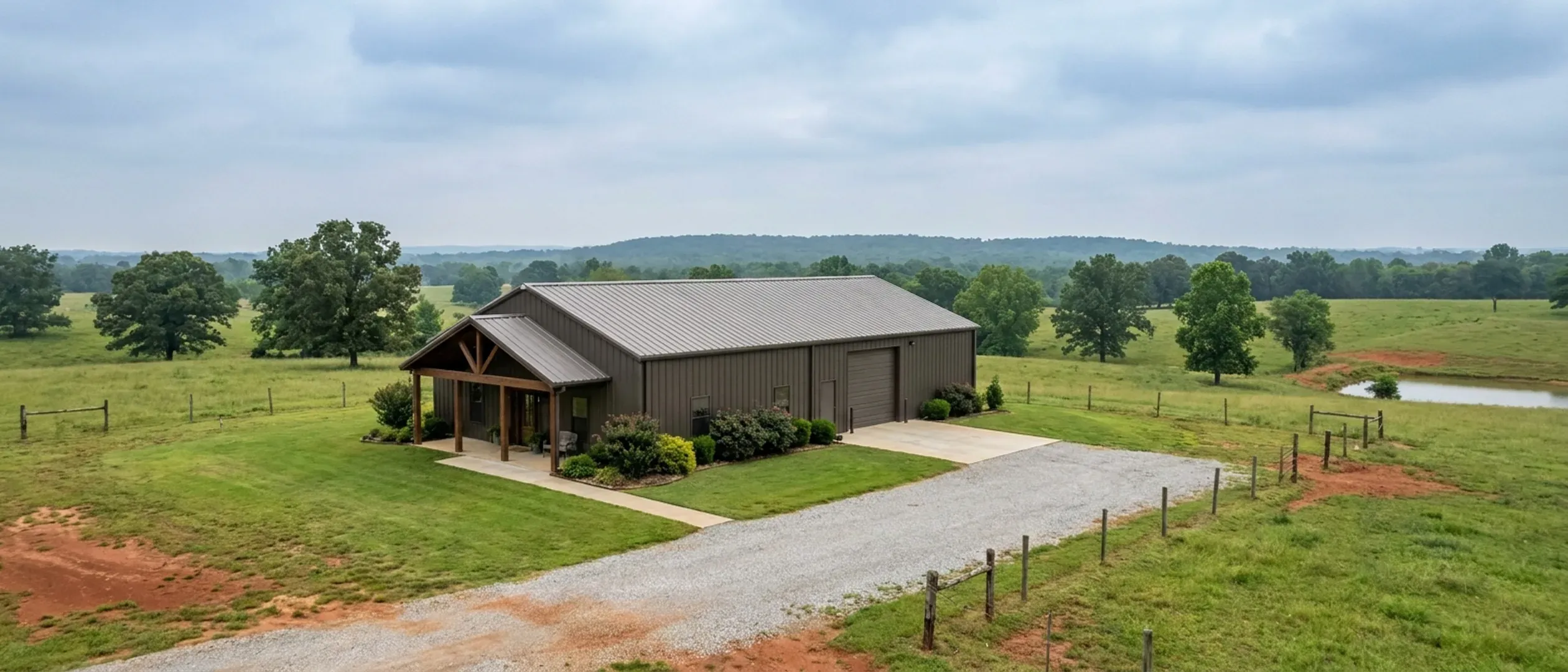
What a Barndominium Costs in Arkansas
Search for what a barndominium costs in Arkansas and you get a per-square-foot range with no author, no year and no method behind it. There is a reason for that: no state agency, no trade association and no government survey publishes a barndominium cost figure for Arkansas. The pages quoting one are quoting each other, and the trail ends at a builder's blog post. So this page does the opposite. It prints only numbers that somebody published under their own name — a city's fee ordinance, a county's quorum court ordinance, an Arkansas Department of Health rule, USDA and Census land data — and then explains, without inventing a figure, what actually decides the rest. The most useful thing on it is a comparison no competing page carries: across the Arkansas jurisdictions researched for this site, the same 2,400 square foot building is priced off five completely different bases, and in two of them it is not priced at all.
Figures on this page are cited third-party or government data, not a quote from Arkansas Barndominium Builders.
What actually moves the number
Which side of a line the site is on
The single largest swing in fixed cost is jurisdictional, not physical. A site inside Bentonville carries four codified impact fees; the same building on unincorporated Washington County ground has a building permit that Ordinance 2025-044 § 5(P) deems issued and never charges for. No two Arkansas counties researched for this site gave the same answer on who permits a house — they run from a full building department with a barndominium checkbox on its application, to a county code whose building article reads, in full, "Reserved."
Site work: slope, rock and pan
Nothing on a barndominium budget is as unpredictable as the ground, and Arkansas publishes the data to check it before you buy. USDA-NRCS SSURGO records a soil restriction within 152 cm across 79.7% of Cleburne County, 70.8% of Garland County and 52.1% of Saline County — rock inside a spade's depth, which turns trenching and footings into blasting or ripping. Web Soil Survey lets a landowner draw their own parcel and read the same data the survey is built from.
The wastewater system
On rural Arkansas ground the septic system is a gate, not a line item. The Arkansas Department of Health's Rules Pertaining to Onsite Wastewater Systems publish a plan-review fee of $30 for a structure of 1,500 square feet or less rising to $150 above 4,000 at § 4.9.1 — but the fee is only the paperwork. Where the soil fails a standard system, § 9 pushes the site onto an alternate, and § 7.4.3 sets a redox-monitoring route that runs 1 December to 15 May and can cost an entire construction season.
Span, bays and big openings
Post-frame gets its economy from fewer, larger structural members and footings only under the columns. That economy is spent again every time the span widens, a bay is added or another overhead door goes into a wall, because the header, the column spacing and the bracing all answer to the opening. It is the reason a 40x60 and a 30x80 with the same floor area do not cost the same.
Finish level, and how much of it is now
The shell is not the building. A finished pole barn home pays for the slab, insulation and air sealing, plumbing, electrical, HVAC, windows, interior finish and fixtures at exactly the same market rate as a stick-built house of the same size, and on a completed project those line items are the majority of the cost. The frame type discounts the structure and discounts nothing else, which is why leaving a shop bay unfinished is the one lever that reliably moves the number.
Whether anyone inspects
An inspection regime costs money in fees and time, and its absence costs money too — differently. Where no building official exists, nobody catches an error before it is buried, no certificate of occupancy exists to hand a lender or an appraiser, and the design decisions the code would have settled land on an engineer's invoice instead. Garland County states on its own addressing page that it issues no certificate of occupancy of any kind. That is a cost, not a saving.
The questions Arkansas actually asks, answered without a made-up number
Every barndominium question the Arkansas search results return is about cost or size. These are the ones that recur, and this is what can honestly be said about each.
How big a barndominium can I build for $100,000?
Nobody can answer that in square feet from a published Arkansas source, because none exists. What can be answered is where a large part of that budget goes before construction starts. On the 2022 Census of Agriculture's own county figures, ten acres of agricultural land and buildings runs about $97,960 in Benton County and about $20,850 in Dallas County — so on the same ten acres, the land alone either consumes the whole budget or a fifth of it. USDA NASS puts the statewide 2026 figures at $4,350 an acre for farm real estate and $3,500 for pasture. Then the published fixed costs stack on top: in Bentonville, four impact fees the city publishes at $3,845 per single-family unit; in Fayetteville, water and wastewater impact fees the city publishes at $5,670 combined; on a septic site, an Arkansas Department of Health plan-review fee between $30 and $150 under § 4.9.1. The land and the fixed charges are knowable to the dollar before you commit. The building is not knowable from any Arkansas source at all.
What does it cost to build a 2,000 sq ft barndominium in Arkansas?
The construction cost is not published. The permitting cost at that exact size is, and it is instructive because three cities reach three different figures for the same building. Springdale publishes a worked example on its own permit pages: a 2,000 square foot dwelling valued at an ICC rate of $94.06 per square foot of heated space gives $188,120, rounded to $189,000, which lands on the § 22-32(b) ladder at a $727.00 permit plus $5.00 for the plastic permit box — $732.00 in total. Jacksonville Municipal Code 16.04.060 presumes construction at $35.00 per square foot of heated and cooled area, so the same 2,000 square feet is a presumed valuation of $70,000 and a permit fee of $148.00 on the ordinance's own arithmetic. North Little Rock charges $0.20 per square foot under roof with a $250.00 minimum at Municipal Code Chapter 4 § 1.2.7(A), plus electrical, plumbing and mechanical at $0.10 each — fifty cents a square foot for the four together, which is $1,000.00 at 2,000 square feet under roof. Same building, three cities, a factor of nearly seven between the highest and the lowest.
What does a 40x60 barndominium cost?
A 40x60 is 2,400 square feet, and it is the one dimension the Arkansas search results ask about by name. Run it through the published schedules and the answer depends entirely on what the jurisdiction measures. Fort Smith Municipal Code § 6-30 sets a minimum valuation of $100.00 a square foot in the 1,801 to 2,500 band, so the city's own table gives a $240,000 valuation and a $394.50 building permit. North Little Rock's per-square-foot schedule gives $480.00 for the building permit and $720.00 for the three trade permits. Searcy Code § 31-2-3(A), as amended by Ordinance 2021-18, charges $15.00 plus $0.30 per square foot under roof, which is $735.00, plus a $25.00 certificate of occupancy. In Bono the same footprint is about $720.00 on a $0.30 per square foot residential permit; in Lake City, which charges $0.07 a square foot, about $168.00. On unincorporated Washington County ground, Ordinance 2025-044 § 5(P) deems the permit issued and there is nothing to pay. Six published schedules, six answers, between roughly nothing and about $1,200 for one building.
How big a barndominium can I build for $200,000?
The same answer, one bracket up, with one addition worth knowing: at higher valuations the fee ladders flatten, so the permit stops scaling with the budget. Rogers publishes a band schedule where a $250,000 valuation works out to $910.00, and above $500,000 the marginal rate drops to $2.00 per additional thousand. Benton County Ordinance O-2024-62 does the same in four steps, from $25.00 for the first $1,000.00 plus $4.00 per thousand at the bottom, to $1,245.00 for the first $500,000.00 plus $1.00 per thousand at the top. Little Rock Ordinance 22,204 runs a $300,000 valuation to a $1,020.00 building permit. So doubling the budget roughly doubles the building and barely moves the permit — which is another way of saying the permit is never the reason a barndominium budget goes wrong.
Is it cheaper to build a barndominium than a house?
The shell usually is, and the shell is not the building. Post-frame construction earns its economy in three places: fewer and larger structural members instead of continuous framing, footings under the columns instead of a continuous perimeter foundation, and a dry-in measured in days rather than weeks. What it gets no discount on is everything a house needs and a barn does not — slab, insulation and air sealing, plumbing, electrical, HVAC, windows, interior finish, fixtures. Those are identical line items at identical market rates whichever frame carries the roof, and on a finished building they are the majority of the cost. The genuine saving is optionality: a barndominium can be finished in stages in a way a conventional house cannot, and an unfinished shop bay is a real budget lever rather than a rhetorical one.
Does a 2 bedroom cost less than a 3 bedroom?
On the building, obviously and unremarkably. On the septic system, the bedroom count is not a proxy for size — it is the design input. The Arkansas Department of Health rule defines a bedroom at § 2.5 as any room inside a residence intended for the purposes of sleeping quarters, and the absorption area is sized from design daily flow and the soil loading rate rather than from floor area. So a third bedroom enlarges the drainfield on ground where a bigger shop does not. The plan-review fee runs the other way: § 4.9.2 excludes auxiliary areas from the square footage that sets the fee band, and § 4.9.2.1 names garages, carports and porches specifically. A shop bay is a garage. A 4,000 square foot building with 1,400 square feet of living space is charged on the living space.
Five ways an Arkansas jurisdiction prices the same building
This is the comparison that makes an Arkansas cost page worth reading. Across the jurisdictions researched for this site, a 2,400 square foot barndominium is not priced high or low — it is priced off bases that do not convert into one another. Find out which one applies before you design, because in three of the five the design decides the fee.
1. An ICC valuation table attached to the ordinance
Benton County Ordinance O-2024-62, adopted by the quorum court on 21 November 2024, prices the building permit off an ICC Building Valuation table dated February 2024 that is attached to the ordinance as an appendix — not off a figure you supply and not off what you agreed to pay a builder. The ladder the ordinance publishes runs $25.00 for the first $1,000.00 plus $4.00 per additional thousand to $50,000.00; then $245.00 for the first $50,000.00 plus $3.00 per thousand to $100,000.00; then $445.00 for the first $100,000.00 plus $2.00 per thousand to $500,000.00; then $1,245.00 for the first $500,000.00 plus $1.00 per thousand. Springdale does the same thing at § 22-32(b) using an ICC rate per square foot of heated space, and Rogers runs heated square feet against the ICC permit fee multiplier for R-3 one- and two-family, Type VB construction. Under this base, a cheap build does not get a cheap permit.
2. A minimum valuation per square foot written into the ordinance
Fort Smith Municipal Code § 6-30 does something almost no Arkansas city puts in print: it sets a floor on what your building is deemed to be worth. The published table is $80.00 a square foot to 1,800 square feet, $100.00 from 1,801 to 2,500, $125.00 from 2,501 to 3,500 and $180.00 at 3,501 and larger, and the fee then runs $37.50 at $2,000.00 of valuation plus $1.50 for each additional $1,000.00. There is one route around it, also in the ordinance: where a claim is made that the figures are not appropriate to the project, the owner or contractor must establish a lesser figure using the Marshall and Swift Valuation Service report. Jacksonville runs the same idea at a different number, presuming $35.00 per square foot of heated and cooled area, or $30.00 per square foot of the whole floor plan including carports, garages, storage rooms, porches and steps where the builder and the City Engineer disagree.
3. Gross square feet under roof — the shop is inside the fee base
This is the base that punishes a barndominium, because it does not care whether a square foot is a bedroom or a bay. North Little Rock charges $0.20 per square foot under roof with a $250.00 minimum at Municipal Code Chapter 4 § 1.2.7(A), plus electrical at § 1.2.8(A), plumbing at § 1.2.9(A) and mechanical at § 1.2.10(A), each $0.10 per square foot under roof. Searcy charges $15.00 plus $0.30 per square foot under roof — and Searcy's own application asks for "Heated & Cooled" and "Under Roof" as separate figures, then charges on the under-roof one. Bono charges $0.30 per square foot under roof; Lake City charges $0.07 for anything larger than an 8 by 10 shed. Under this base a 1,600 square foot house with an 800 square foot attached shop pays exactly what a 2,400 square foot house pays.
4. Heated square feet only, or declared cost of construction
Rogers reads heated square feet and nothing else, which is the friendliest base in the state for this building type — an unheated shop bay is outside the fee entirely. Little Rock reads declared cost of construction instead, with a threshold underneath it: Ordinance 22,204 requires a permit for any work exceeding $5,000.00 including material and labour, or requiring an inspection, then charges $50.00 for the first band plus $4.00 per additional thousand up to $50,000, rising through $250.00, $420.00 and $1,620.00 band bases, with a $50.00 minimum, a $25.00 non-refundable data processing fee on every permit and a $30.00 residential certificate of occupancy. Bentonville also runs on valuation, from a $30.00 minimum through bands to $2,120.00 for the first $500,000 plus $2.00 per additional thousand.
5. Not priced at all — and that is not the same as free
Washington County Ordinance 2025-044, which the ordinance titles The Freedom and Property Preservation Zoning Act of Washington County, zones every unincorporated acre and then provides at § 5(P) that "building permits are hereby deemed to be issued for agricultural and single-family residential uses." A permit that is deemed issued is never applied for, never priced, never reviewed and never inspected. Saline County goes further: no county building permit exists at all, and the only construction permit in its code is a $20.00 road right-of-way permit under section 1200.02, which also requires a $10,000 surety bond in force for a year after the work. Sebastian County's entire codified building law is one paragraph setting a 25-foot setback from the county road right-of-way. Craighead County and Faulkner County both have a codified chapter headed Urban / Rural Development whose building article reads, in full, "Reserved."
The charges that are not the building permit
On most Arkansas projects the building permit is the smallest published number in the file. These are the ones that are larger, and the ones people most often leave out of a budget.
Impact fees, where a city has them
Bentonville publishes four codified impact fees on a single-family detached unit — Fire/EMS $532, parks and open space $2,521, library $442 and police $350 — $3,845 in total, payable as a condition of issuing the certificate of occupancy, plus a $500 refundable construction deposit at permit purchase that is forfeited if anyone moves in early. The exemption matters enormously here: construction of unoccupied accessory structures related to a residential unit is exempt, so a detached shop with no living space in it pays none of Bentonville's $3,845 and a shouse pays all of it. Fayetteville publishes a different set — water at $2,672 and wastewater at $2,998 for an average single-family dwelling, $5,670 combined, plus $150 per dwelling for fire protection and $162 for police and public safety, with tap fees charged on top and priced differently inside and outside the limits.
Trade permits, which are often the larger half
In North Little Rock the three trade permits together cost more than the building permit — $0.10 per square foot under roof each against $0.20 for the building. Jonesboro publishes residential electrical, plumbing and HVAC at $0.05 per square foot each on fee resolutions RES-17:091 and RES-17:092, alongside a $50.00 planning review for a new single-family dwelling, $25.00 for a detached accessory structure, a $40.00 residential gas test, a $40.00 water meter permit, a $40.00 sewer permit and a flat $50.00 storm shelter permit. Fayetteville charges electrical at $2.03 per $1,000 of valuation, gas at $2.03, mechanical at $3.31 and plumbing at $3.04, each with a $55 minimum, plus a plan review fee equal to half the permit fee collected before review begins and a Craft Education Program charge of fifty cents per $1,000 of valuation.
The utility connection, which is invisible until it is not
Bono publishes a residential three-quarter-inch water meter at $1,050.00, or $650.00 if the owner installs the setters, and a one-inch meter at $1,550.00 — larger than any building permit in the county. Fayetteville prices a 1-inch water tap at $525 inside the limits and $575 outside. On rural ground there is no meter at all and the equivalent line is a well, which Arkansas does not require a permit to drill for domestic use, or a rural water association tap, which quietly defeats the agricultural plumbing exemption at Arkansas Code § 17-38-302(2) the moment it is connected.
The address, the driveway and the floodplain permit
Rural Arkansas replaces the building permit with a short list of small permits that still gate the build. Pulaski County's Road and Bridge Department charges $40.00 per culvert for a private access driveway permit and prices a floodplain development permit at two cents per square foot of ground floor area. Faulkner County Code § 1200.04 makes a driveway onto a county road without the County Judge's permit a continuing misdemeanour at up to $250.00 a day. North Little Rock charges $25.00 for a floodplain development permit and $50.00 to $300.00 for a grading and fill permit by acreage. Benton County charges $50.00 for one acre or less and $100.00 above that for stormwater and floodplain permits alike.
Re-inspections and starting early
These are the avoidable ones and they are not small. Fayetteville charges triple the permit fee with a $250 minimum penalty for work started before the permit issues, and its own code adds that paying the triple fee does not excuse compliance. Springdale doubles the fee in the same circumstance. The Searcy ordinance fines $100.00 per day, each day a separate offence. Benton, in Saline County, publishes a $1,000-per-day fine for working without a permit. Rogers charges $100.00 for a repeat re-inspection of the same deficiency and will not schedule anything else on the project until it is paid; Fayetteville charges $125 for a re-inspection, payable before the next one.
The onsite wastewater file
The Arkansas Department of Health plan-review fee published at § 4.9.1 is $30.00 to 1,500 square feet, $45.00 to 2,000, $90.00 to 3,000, $120.00 to 4,000 and $150.00 above, with alterations at $30.00. That is the paperwork only — not the designer's fee, not the installer's, not the excavation. The permit comes in three parts under § 4.10, and the third one matters to a schedule: the system may not be used until the Permit for Operation issues, which follows an approved installation inspection. Under § 4.3 the septic permit precedes the building, not merely the building permit, which reorders the front of an Arkansas project in a way buyers routinely discover late.
What actually moves the number, and how to check it before you buy
None of these can be priced from a published Arkansas source. All of them can be investigated before an offer, which is worth more than a range someone made up.
Read the soil before you read the listing
USDA-NRCS Web Soil Survey lets a landowner draw their own parcel and read the same SSURGO data every figure on this page comes from — depth to a restrictive layer, shrink-swell, drainage class, the presence of a fragipan. That single free step separates a site where a conventional drainfield and a spread footing both work from one where the septic goes to an alternate design under § 9 of the Arkansas Department of Health rule and the foundation goes to an engineer. A parcel a thousand dollars an acre cheaper that needs either of those is not cheaper.
Slope is a septic constraint before it is a foundation one
The Arkansas Department of Health rule caps the absorption area slope for a capping fill at 12% at § 8.7.4 and requires a variance above it at § 8.7.8, and holds surface-discharging systems to the same 12% at § 9.7.6, with a minimum lot size of three acres at § 9.7.1 and a discharge point at least 300 feet from any adjacent dwelling. Two thirds of Madison County is mapped above 12% slope. On that ground the slope decides the wastewater system, the wastewater system decides the house position, and the house position decides the driveway and the utility run — three cost items chained to one map.
Karst, and the one thing it makes impossible
In the Ozark counties the limestone is soluble and the ground is not always where it appears to be. Rogers is explicit about the consequence in its own rules: the Cave Springs karst regulations prohibit basements outright across the two highest-vulnerability zones. Benton County has the most mapped sinkholes in the state, and SSURGO's low shallow-bedrock share there is not evidence against karst — the Boone Formation weathers to a deep cherty residuum, so no restriction is recorded within 152 cm even where carbonate rock is the parent material.
Design criteria, and who publishes them
Wind speed, ground snow load, frost depth and seismic design category are a jurisdiction fill-in, not a state constant, and most Arkansas jurisdictions publish nothing. Rogers is one of the very few that prints an actual design-criteria block — snow load, wind speed, seismic category, frost depth and air freezing index, in plain paragraph form on the Fire Department's own codes page. Where no jurisdiction has published them, somebody still has to choose them, and that somebody is an engineer whose fee is a real line in the budget. In north-east Arkansas the New Madrid Seismic Zone makes that choice consequential rather than formal.
The trades reach further than the building code does
Arkansas Code § 17-38-103(a) gives the state plumbing code the effect and force of law as minimum standards statewide, applying to all types of buildings, private or public, rural or urban. Electricians, plumbers and HVACR mechanics are licensed by the State everywhere in Arkansas, city or no city, permit or no permit. The agricultural exemption at § 17-38-302(2) exempts the licensing requirement and not the code, and it fails on a barndominium anyway, because the first of its three conditions is that the building's primary use is agricultural — and a barndominium's primary use is residential. On rural Arkansas land the trade licences reach further than the building code does.
Before you sign anything
Two checks cost nothing and are worth more than any estimate on this page.
Confirm the licence, because the statute makes it your problem too
Arkansas Code § 17-25-513(3)(A) puts the residential building contractor licence requirement on any project over $2,000, and the board's own residential classification expressly covers detached garages, storage buildings, detached structures and metal buildings alongside the dwelling. Fort Smith puts the same rule in its own code and will not issue the permit until a state licence is in the file. Verify the licence number with the Contractors Licensing Board before the contract, not after — Arkansas Code § 17-25-103(d) makes an offending contract unenforceable and bars quantum meruit as well, which is a remedy problem for both parties rather than a penalty on one.
Establish which of the five bases applies to your parcel
Call the jurisdiction the parcel actually sits in, not the nearest city with a name on the mailing address, and ask three questions: is there a building permit, what is the fee measured on, and does the shop count. The answers change the design before the first sketch, because a heated-square-feet jurisdiction rewards an unheated shop and an under-roof jurisdiction charges the same for it as for a bedroom. Where the answer is that no permit exists, ask the next question instead — what the Arkansas Department of Health needs to see before the septic permit issues, because on that ground it is the only approval standing between you and a mistake nobody will catch.
Reading this because you are weighing a build? The next step is a plan drawn for your program.
What's different about Arkansas
There is no measured Arkansas cost figure, and the census division matters
Every national per-square-foot construction average is compiled by census division. Arkansas sits in the West South Central division — not the South Atlantic, and not the Delta States grouping USDA uses for farm land. A figure regionalised to the wrong division is a wrong number wearing a citation, and a figure with no division and no year attached is not telling you anything at all. When a page quotes you an Arkansas barndominium cost, the questions that settle it are: who published this, in what year, and for which division?
The code applies statewide; the counter mostly does not
Arkansas adopted the 2021 Arkansas Fire Prevention Code by rule, effective 1 January 2023, and Volume III is the 2021 International Residential Code with Arkansas amendments. Its scope at R101.2 covers detached one- and two-family dwellings and their accessory structures, which puts a barndominium and its shop squarely inside it. But the code hands enforcement to a building department a jurisdiction is merely "authorized to establish," and most of rural Arkansas never has. The owner-application fallback to the State Fire Marshal was written into Volume II only. On rural residential land the code follows the building and the counter does not.
Act 314 of 2025 pulled the city counter back to the city limit
Until 2025 an Arkansas city of 8,000 or more administered planning ordinances one, two or three miles out into the county. Act 314 of 2025 repealed Arkansas Code § 14-56-413 outright and abolished municipal extraterritorial planning jurisdiction statewide, along with the provision that had let a city extend electrical permit jurisdiction into the same ring. Land in the old ring around Fayetteville, Springdale, Rogers, Bentonville and Jonesboro reverted to whatever the county itself adopted. Any Arkansas source written before August 2025 should be treated as stale on this point, and free legal mirrors still serve the repealed section as live law.
The contractor threshold is $2,000, not $50,000
Arkansas Code § 17-25-513(3)(A) lists the exemption from the residential building contractor requirement as a project where the cost of the work done or to be done does not exceed $2,000, and subdivision (3)(B) expressly defeats splitting a project into smaller contracts to get under it. Per project, not per contract and not per year. The statute lists two other $50,000 figures and neither is a licensing threshold: § 17-25-506(a)(1), a financial-statement filing trigger, and a scope cap on one limited licence tier. Rogers states the correct rule on its own residential construction packet: a state contractor licence for any residential building project over $2,000.
An unlicensed contract is unenforceable, and so is the fallback
Arkansas Code § 17-25-103(d) contains two separate bars in two sentences: no action may be brought at law or in equity to enforce a contract entered into in violation of the chapter, and no action may be brought for quantum meruit either. Quantum meruit — the equitable claim for the reasonable value of work actually done — is the unlicensed builder's last resort in most states, and Arkansas closed it by name. There is no substantial-performance exception on the face of the section. For an owner, that is a due-diligence step worth more than any line item: check the licence before the contract, not after the dispute.
Expansive clay is a Delta problem, and the building shape makes it worse
USDA-NRCS SSURGO puts Vertisols — the soil order defined by shrink-swell — at 43.6% of the Chicot survey area, 34.8% of Desha and 33.7% of Crittenden, with linear extensibility of 6 or more across more than half of each. A barndominium is close to the worst possible shape for that ground: wide, so differential heave spans more soil variability; light, so there is less dead load resisting swell; slab-dominated, so movement shows up directly as floor movement; and usually built with a large overhead door in one wall, the least tolerant element in the building of a racked frame. The Arkansas Geological Survey's own language is that structures "can literally break apart" where it is not considered during construction.
Fragipan and shallow bedrock decide the septic answer
SSURGO records a fragipan across 40.2% of the Benton County survey area, 37.5% of Sebastian, 31.5% of Faulkner and 25.1% of White — a dense pan that perches water above itself through winter and spring. The Arkansas Department of Health rule treats it as a Restrictive Soil Layer at § 2.44 and forbids monitoring wells below its top at § 7.4.3.5. Shallow bedrock runs the other way geographically, at 79.7% of Cleburne and 79.0% of Van Buren against 0.0% across most of the Delta. These two maps, not the asking price per acre, are what decide whether a parcel takes a conventional drainfield.
Land is a bigger variable in Arkansas than the listings suggest
USDA NASS, in its Land Values 2026 Summary, puts Arkansas farm real estate at $4,350 an acre, cropland at $3,850 and pasture at $3,500 — a gap of only about 9% between grazing land and row-crop ground, which is unusually narrow and is the market saying the buyer for a 40-acre Ozark pasture is not a cattleman. County extremes are far wider: the 2022 Census of Agriculture puts agricultural land and buildings at $9,796 an acre in Benton County against $2,085 in Dallas County, either side of a state average of $3,921. On ten acres, those two Census figures put the land alone roughly $77,000 apart before anything is built.
Pros and cons, honestly
Pros
- The published fixed costs are genuinely knowable before you commit — permits, impact fees, wastewater review and land per acre are all printed by somebody under their own name.
- The permit stops scaling long before the budget does: Rogers reaches $910.00 at a $250,000 valuation and Little Rock $1,020.00 at $300,000, so the permit is almost never why a budget fails.
- Staged finishing is real rather than rhetorical on this building type — the shop bay can be dried in now and finished later without touching the structure.
- Arkansas publishes unusually good free site data. SSURGO through Web Soil Survey, FEMA flood maps and the Arkansas Department of Health rule between them answer most of what decides a site.
Cons
- No Arkansas barndominium cost figure exists from any agency, survey or trade body, so every quoted range on the internet traces back to a builder with something to sell.
- Impact fees and utility connections dwarf the permit where they apply — $3,845 per unit in Bentonville, $5,670 in Fayetteville, $1,050.00 for a water meter in Bono.
- Where a fee runs on square feet under roof, the shop bay is inside the fee base and costs exactly what living space costs.
- The absence of an inspection regime is a cost as well as a saving: no certificate of occupancy for a lender or appraiser, and design decisions that land on an engineer's invoice instead of in a code table.
- Ground conditions are the largest genuinely unpredictable item, and the two worst — expansive Delta clay and Ozark karst — are at opposite ends of the state.
Why won't this page give me a price per square foot for Arkansas?
What does a building permit actually cost in Arkansas?
Are the impact fees and utility connections really bigger than the permit?
Do I need a licensed contractor in Arkansas, and what is the real threshold?
What happens to my money if the contractor turns out to be unlicensed?
What does the septic system add to an Arkansas barndominium budget?
Is it cheaper to build a barndominium than a conventional house in Arkansas?
Does it cost less to build where there is no building department?
Questions answered? Tell us what you want to build and we will put real numbers against it.
Keep reading
The pages that answer the next question this one raises.
The Arkansas building code, and who actually enforces it
Which code applies on unincorporated land, why the counter usually is not there, and what Act 314 of 2025 changed.
Read itBuying land for a barndominium in Arkansas
How to read a parcel for slope, rock and drainfield before you make an offer — the checks that decide the site-work half of the budget.
Read it40x60 barndominium plans
The one dimension Arkansas searches ask about by name, and the size the permit comparison on this page is worked at.
Read itBarndominium kits
What a kit includes and what it leaves for the site, which is where the difference between a shell price and a finished building lives.
Read itWant a real number instead of a range?
Start your plans and we will come back with a budget for what you actually want to build, not a national average. Send the parcel ID or an address when you have one and we will price it against your land. That conversation costs nothing.