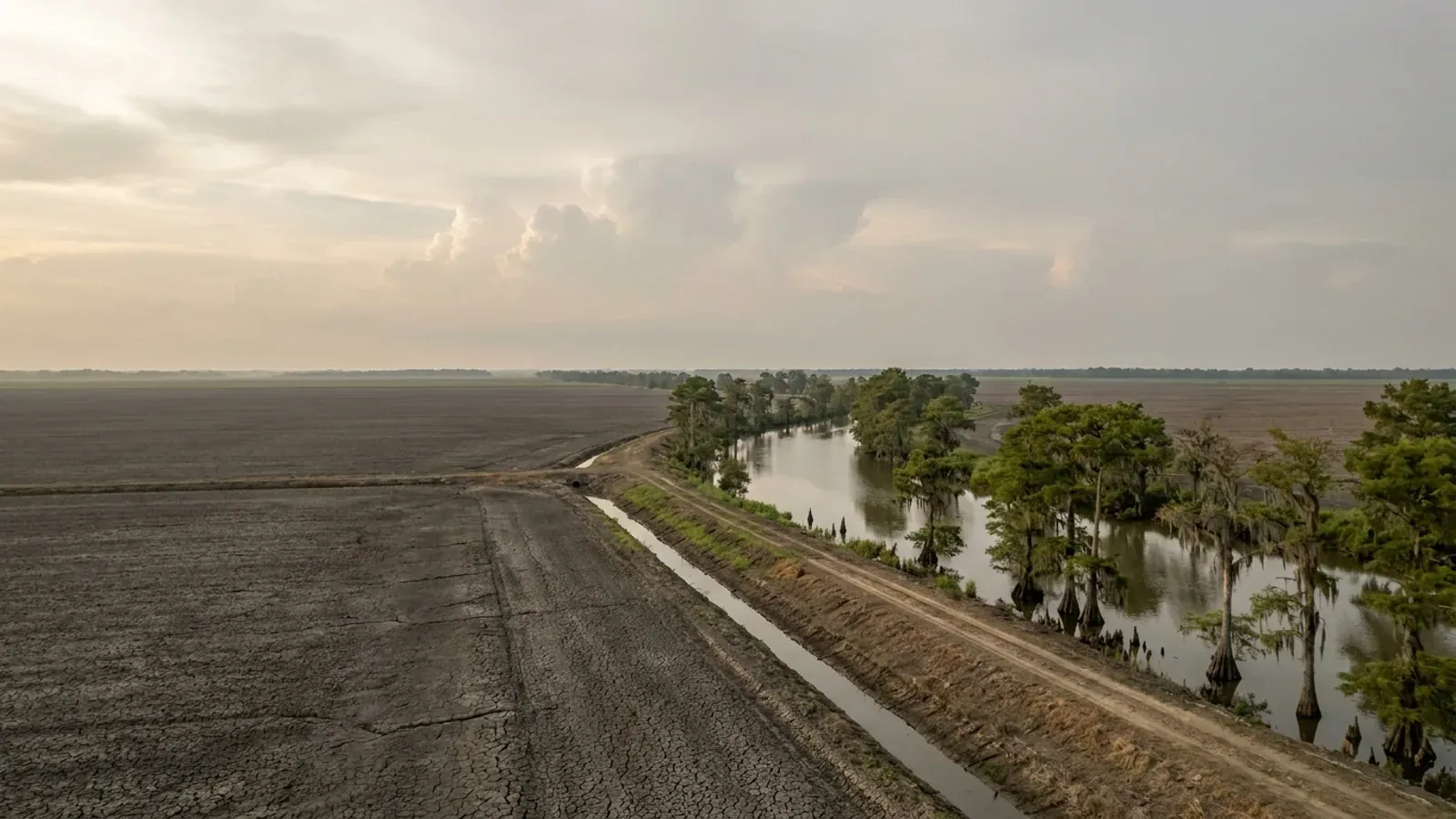
Flat Delta cropland running to the horizon with a drainage ditch, a cypress-lined bayou and a huge open sky.
Jefferson County Statewide code, local enforcement optional

Barndominium Builders in Pine Bluff, AR

Pine Bluff is a city of 38,213 people that has lost population at every census count since 2000, and it has one of the more complete permit counters in Arkansas: its own inspection department, its own building official, a published valuation-based permit fee and a zoning ordinance with a five-acre agricultural-residential district. What it does not have around it is the land most barndominium buyers picture. Jefferson County is 53 percent farmland, but 80 farms hold 86 percent of that farmland, 46 of them at 2,000 acres or larger, and 68 percent of it is irrigated row crop behind levees. So this page does two jobs: it tells you exactly what the City of Pine Bluff will and will not let you build inside the limits, and it points you at the timbered southern and western half of the county, and at Cleveland County next door, where tracts actually change hands in homesite sizes.

Pine Bluff at a glance

County
Jefferson County
Population
38,213
ZIP codes
71601, 71602, 71603
Site visits
Pine Bluff sits at the southeast end of the Central Arkansas belt we work, and so does the timbered country south and west of it toward Rison and Star City, which is where this page sends you for acreage.

Building conditions in Pine Bluff

The State's code reaches every parcel in Arkansas, including rural and unincorporated land. What is not everywhere is the office that checks it: a city or county is authorised to set up a building department, not required to, and a great deal of rural Arkansas never has. So the first question on any parcel is not what the code says — that part travels — but whether anyone here issues a permit, inspects the work, or publishes the design criteria your drawings still have to satisfy. Where nobody does, the obligation does not go away. It just moves to the appraiser, the insurer, your lender and whoever buys the place from you.

Build conditions for Pine Bluff , Jefferson County, Arkansas . BUILD CONDITIONS PINE BLUFF, ARJefferson CountyONE STATEWIDE CODEADOPTED RESIDENTIAL CODEONE STATEWIDE CODEThis jurisdiction publishes no design wind speed. It is settled in writing with the authority overyour parcel before the frame is ordered.ZONING · R-1 RESIDENTIAL IS THE STANDARD SING…R-1: 8,400 sq ft, 70 ft wide at the…R-1 setbacks are 30 ft front, 20 ft rear, and a total side yard of20 percent of lot width with no side under 7 ft; maximum building…PINE BLUFF BUILDING PERMIT FEE (VALUATION-BAS…$504.00 plus $2.00 per $1,000 of val…From section 7-47(4), rewritten by Ordinance No. 6798 on 17 April2023. The bands run: no fee under $500 of valuation unless an…WHO ISSUES THE PERMITCity of Pine Bluff Inspection Depart…Called the zoning and inspection department in section 7-26, whichstaffs it with a chief inspector, chief housing inspector, building…
Build conditions for Pine Bluff, drawn from the sourced facts on this page. Every figure above is cited in the quick-facts panel below, with its source and vintage.
Eighty farms hold 86 percent of Jefferson County's farmland, and 46 of them are 2,000 acres or larger
This is the number that decides whether a land search here is realistic. The 2022 Census of Agriculture counts 375 farms in Jefferson County holding 296,354 acres, 53.2 percent of the county's 556,770 acres. Forty-six of those farms are 2,000 acres or larger and they hold 206,367 acres between them, seventy percent of all the farmland in the county. Another 34 farms of 1,000 to 1,999 acres hold 48,416 acres. Together, 80 farms hold 86 percent of it. At the other end, 184 farms are under 100 acres and they hold 7,272 acres between them, two and a half percent of the total. The median farm is 105 acres, which sounds buyable, but the median is counting a long tail of small tracts while the ground itself sits in irrigated blocks: 200,505 acres, 68 percent of the county's farmland, is irrigated. Average farm size is 790 acres and rose 18 percent between 2017 and 2022.

https://www.nass.usda.gov/Publications/AgCensus/2022/Full_Report/Volume_1,_Chapter_2_County_Level/Arkansas/st05_2_008_008.pdf

The buyable half of the county is south and west, and it runs on into Cleveland County
Jefferson County straddles two physiographic provinces and they behave completely differently in a land search. North and east of Pine Bluff is Mississippi Alluvial Plain: Perry and Portland clays, rice and soybean ground behind levees, held in the blocks above. South and west is West Gulf Coastal Plain. A USDA-NRCS Soil Data Access query over the Jefferson and Lincoln survey area returns 147,979 acres of soils formed in loamy marine deposits and another 52,984 acres in loamy and clayey marine deposits, carrying Savannah, Sacul, Sawyer and Smithdale, which are timbered upland series and not cropland. Cleveland County, the other half of the Pine Bluff micropolitan area, is the same country and the contrast in the same federal table is stark: 208 farms, only 10.3 percent of its 382,582 acres in farms, no farm in the county at 2,000 acres or more, and agricultural land assessed at $3,733 an acre against Jefferson's $3,494. Grant County to the west and Lincoln County to the south are the other two directions worth driving.

https://www.nass.usda.gov/Publications/AgCensus/2022/Full_Report/Volume_1,_Chapter_2_County_Level/Arkansas/st05_2_008_008.pdf

Pine Bluff publishes its permit fee, then charges half of it again for the plan review
Section 7-47(4) of the Pine Bluff Code, rewritten by Ordinance No. 6798 on 17 April 2023, prices a building permit on construction valuation: $504.00 for the first $100,000 plus $2.00 per additional thousand up to $500,000, above bands of $15.00 plus $6.00 per thousand to $50,000 and $204.00 plus $4.00 per thousand to $100,000. Section 7-10, added by Ordinance No. 6731 on 15 November 2021, then requires the plans for any new single-family residence to be reviewed by the inspection department before a permit issues, at a non-refundable fee equal to half the permit cost. On a $250,000 valuation that is $804.00 for the permit and $402.00 for the review, $1,206.00 in total, before the $75.00 certificate of occupancy and the separate electrical, plumbing and mechanical permits. Start work without a permit and section 7-46(b) makes the fee triple.

https://library.municode.com/ar/pine_bluff/codes/code_of_ordinances?nodeId=COOR_CH7BUBURE_ARTIIIBUCO_S7-47AM

Jefferson County has no planning board, no zoning and no building department
Arkansas county land-use control is a two-step opt-in. Under A.C.A. 14-17-203(a) a county judge may create a county planning board with the quorum court's approval; only then may the court adopt a zoning ordinance, which 14-17-209(c) says is observed through denial of the issuance of building permits and use permits. Jefferson County has taken neither step. Its own published department list runs circuit clerk, circuit courts, assessor, clerk, coroner, county judge, treasurer, district courts, environmental office, emergency management, MECA, prosecuting attorney, quorum court, recycling, road department, sheriff, tax collector and veterans service, with no planning, zoning or building department anywhere in it. The two land-use counters that do exist are the Office of Emergency Management, which issues floodplain development permits, and the Environmental Office, which the county describes as enforcing county codes for road and land use, issuing permits and dealing with conditional use permit holders. Unlike Faulkner and Craighead counties, Jefferson has no Association of Arkansas Counties codified code of ordinances published on Municode either.

https://www.jeffersoncountyar.gov/government/office-of-emergency-management/floodplain-development

Also worth knowing before you build in Pine Bluff

Nearly half of Jefferson County sits behind a levee
The Arkansas Levee Task Force, created by Executive Order 19-10, had the Arkansas Geographic Information Systems Office overlay the Corps of Engineers National Levee Database leveed areas on county assessor tax parcels. Jefferson County took two volumes. The northern report puts 129,353.12 acres of parcels intersecting the leveed area, of which 120,347.70 acres lie inside it; the southern report puts 142,219.96 acres of parcels intersecting, of which 134,372.45 acres lie inside. That is 254,720 acres of leveed area against a county of 556,770 acres. The same reports carry the Corps' June 2019 forecast Arkansas River flood: 22,002.85 acres in the north and 25,003.78 in the south, 47,007 acres of parcel land under forecast flood water in a single event.

https://gis.arkansas.gov/docs/arkansas_levee_task_force/Jefferson_Leveed_Parcels_Report_South.pdf

The dominant soil here is a 60-to-85-percent clay that floods yearly unless a levee stops it
Perry is the single most extensive major soil component in the Jefferson and Lincoln survey area at roughly 146,600 acres, ahead of Rilla at about 91,300 acres and Portland at about 78,400. The NRCS Official Series Description for Perry, a very-fine smectitic thermic Chromic Epiaquert established in Perry County, Arkansas in 1920, states that the average clay content of the 10 to 40 inch control section ranges from 60 to 85 percent, that montmorillonite is the dominant clay mineral, that the soils are poorly drained with very slow permeability, and, in the sentence that ties the ground to the levee, that Perry soils are on level to gently undulating slopes in backswamp areas along the Arkansas and Red Rivers and their distributaries and are flooded for short periods nearly every year unless protected by levees. Portland, the third most extensive, carries a seasonal high water table within 12 inches of the surface from December through May.

https://soilseries.sc.egov.usda.gov/OSD_Docs/P/PERRY.html

Not one acre in the survey area is rated Not limited for a septic field
A USDA-NRCS Soil Data Access query of the ENG - Septic Tank Absorption Fields interpretation across the Jefferson and Lincoln survey area returns 680,756 acres rated Very limited and 142,184 acres rated Somewhat limited, with 128,245 acres not rated. The Not limited class does not appear at all: of the acreage NRCS rates, 83 percent is Very limited and the remaining 17 percent is Somewhat limited. The same database's April-to-June water table depth puts 72,871 acres with water within 30 cm of the surface and a further 407,058 acres between 30 and 60 cm, so roughly 480,000 acres carry a seasonal high water table inside two feet in late spring. Flood frequency ratings add 100,699 acres occasionally flooded and 67,285 acres frequently flooded. Get the onsite wastewater design in front of the Arkansas Department of Health before the pad is shaped, not after.

https://sdmdataaccess.sc.egov.usda.gov/

No PEX under the slab in Pine Bluff
Section 7-242 of the city code amends four sections of the adopted Arkansas State Plumbing Code, and one of them lands squarely on a slab-on-grade build. As amended, Section 10.1.4 reads that water piping when underground and within a building perimeter shall be of cast iron or galvanized pipe, or Type L or K copper tubing, except when under a slab such pipe shall be cast iron or Type K or L copper pipe. The amended Section 10.1.3 does allow polyethylene (PEX) above ground inside the building envelope, so the restriction is specifically about what goes under the concrete. Section 11.2.1 restricts building sewer material, and section 7-247 requires cast-iron sewer pipe within the street or alley right-of-way to the property line. The plumbing permit fees are $5.00 per fixture, $30.00 for a new or replaced water service, $20.00 for sewage and $20.00 each for house gas piping and a gas service line, with three inspections required under section 7-245.

https://library.municode.com/ar/pine_bluff/codes/code_of_ordinances?nodeId=COOR_CH7BUBURE_ARTVIIPLGASY_S7-242AMPLCO

The A-R district asks for five acres and will not let a metal storage building become a guest house
Section 29-121 sets the A-R agricultural-residential district minimum lot at five acres, 300 feet wide and 300 feet deep, and requires the tract to be under one legal description on record at the Jefferson County Court House as a single parcel at the time the A-R rezoning is applied for. The main building and all accessory structures together may not occupy more than 25 percent of the tract. One guest house is allowed alongside the primary residence, and the ordinance defines it as a site-built, self-contained living unit in a detached structure subordinate in both land coverage and gross floor area to the principal dwelling, then adds that mobile homes, manufactured or modular housing are not permitted as guest houses and that metal structures of any type built and intended for residential storage purposes are not permitted as guest houses and cannot be modified for such. Unconfined livestock are allowed at one animal per half acre. Front yards in A-R are measured from the centre of the road.

https://library.municode.com/ar/pine_bluff/codes/code_of_ordinances?nodeId=COOR_CH29ZO_ARTIVDIRE_S29-121AGSIDI

Attach the shop to the house with a roof and it stops being an accessory building
Pine Bluff does not cap accessory buildings by floor area or as a percentage of the house, the way several other Arkansas cities do. It controls them three other ways. First, the definition at section 29-2: where part of the wall of an accessory building is part of the wall of the principal building, or where an accessory building is attached to the principal building in a manner as by a roof, that accessory building shall be counted as part of the principal building. Second, placement and coverage: accessory buildings must sit at least five feet from any property line and only in side and rear yards, and total building coverage in R-1 may not exceed 45 percent of lot area. Third, the same definition bars semi-truck trailers, railroad cars, tents, yurts, canopies, portable storage containers, mobile homes, manufactured housing, portable offices and recreational vehicles or campers from being accessory buildings at all, and requires both a zoning permit and a building permit before one is erected. Note also that a private garage is defined at a capacity of no more than three vehicles, or one per family housed in the building, whichever is greater.

https://library.municode.com/ar/pine_bluff/codes/code_of_ordinances?nodeId=COOR_CH29ZO_ARTIINGE_S29-2DE

The city's subdivision ordinance still claims a territorial jurisdiction Arkansas abolished in 2025
Act 314 of 2025, approved 18 March 2025, repealed A.C.A. 14-56-413 outright and ended municipal extraterritorial planning jurisdiction across Arkansas, along with 14-17-208(i), 14-38-101(b)(1)(B), 14-40-208, 14-56-417(c), 14-56-422(5)(B) and 17-28-305(b)(3). Under the repealed section a city of Pine Bluff's census size administered planning one mile beyond its corporate limits. Pine Bluff's subdivision regulations have not caught up: as codified through Ordinance No. 6888, enacted 7 July 2026, Chapter 25 still defines territorial jurisdiction as all land lying within the planning area of the planning commission, still cross-references extraterritorial jurisdiction to that definition, still applies to the official planning area jurisdiction map, and still makes violation within the corporate or extraterritorial limits a misdemeanour. The code comparative table shows Chapter 25 was last amended in 2003. One municipal reach outside the limits does survive Act 314 because it hangs on the utility rather than on territory: section 7-244 requires a plumbing permit before any plumbing work in the city or on any properties connected to the public water supply outside the city limits.

https://www.arkleg.state.ar.us/Home/FTPDocument?path=%2FACTS%2F2025R%2FPublic%2FACT314.pdf

Pine Bluff has lost roughly a third of its people since 2000
The Census Bureau's own city files trace it. The 2000 census count was 55,224. The 2010 census count was 49,083. The Bureau's 2025 vintage estimates put the 2020 base at 41,259 and 1 July 2025 at 38,213, a fall of 30.8 percent across twenty-five years and three consecutive decennial declines. Jefferson County as a whole went from 67,254 in 2020 to 62,987 in 2025, minus 6.3 percent, one of the fifteen fastest-shrinking counties in Arkansas. The unincorporated balance of the county, everything outside Pine Bluff, White Hall, Redfield and the smaller towns, holds 16,686 people. Competitors will not tell you this, and it matters commercially rather than sentimentally: thin comparable sales, cautious appraisals and a shorter bench of subcontractors are the practical consequences, and they are why a stamped engineer's design and a documented inspection trail carry more weight here, not less.

https://www2.census.gov/programs-surveys/popest/datasets/2020-2025/cities/totals/sub-est2025_5.csv
The city adopts the 2020 NEC and then names one section it will not enforce
Section 7-161 adopts the 2020 National Electrical Code with all appendices except Appendix H, and then states that consistent with the rules of the Arkansas Department of Labor, Section 210.8(F) of the 2020 National Electrical Code, which deals with GFCI requirements for heating, ventilation and air conditioning, will not be enforced. That amendment came in on Ordinance No. 6782 on 21 November 2022. The rest of the city's adopted list is unusual enough to be worth reading before an engineer picks a code path: section 7-46 adopts the 2021 International Existing Building Code as the city's building code, section 7-181 adopts the 2012 International Residential Code as the property maintenance code, section 7-226 adopts the 2021 International Mechanical Code, section 7-241 adopts the 2018 Arkansas State Plumbing Code and the 2018 Arkansas Fuel Gas Code, and section 7-1.1 adopts the 2014 Arkansas Energy Code. Section 7-47(2) then provides that codes referenced elsewhere shall be interpreted to mean the applicable code adopted by the City of Pine Bluff.

https://library.municode.com/ar/pine_bluff/codes/code_of_ordinances?nodeId=COOR_CH7BUBURE_ARTIVEL_DIV4TEST_S7-161ADCO

Splitting a tract here is a counter transaction, not a commission hearing
Section 25-38 makes any subdivision of five lots or fewer a minor subdivision, processed for plat approval or disapproval by the zoning administrator rather than the planning commission, after he confers with and receives the approval of the city planning director and the city engineer. He must approve or disapprove within thirty calendar days of the developer submitting everything in writing, and the developer may appeal his decision to the planning commission. A lot split goes in as a sketch and a final, and where the zoning administrator is satisfied the division meets minimum zoning and health regulations as well as the technical subdivision rules, no plat need be filed at all. Section 25-40 prices a lot split at $25.00, a replat at $20.00 where no preliminary plat is required, and preliminary or final plat approval at $125.00 plus a dollar a lot.

https://library.municode.com/ar/pine_bluff/codes/code_of_ordinances?nodeId=COOR_CH25SU_ARTIIPLPR_DIV1GE_S25-38MISULOSP

The floodplain permit is $75, and the city's plat rule cites the Corps of Engineers, not FEMA
Pine Bluff adopted its Flood Damage Prevention Code by reference in Ordinance No. 6273 on 17 February 2009 and filed it with the city clerk rather than printing it in the code. What is printed is the fee: section 11-1(b) sets the charge under paragraph (4), section D, article 2 of that code at seventy-five dollars, raised there by Ordinance No. 6730 on 15 November 2021. Alongside it, section 25-12 of the subdivision regulations provides that land may not be platted and subdivided except in conformance to the city's floodplain regulations, that the city will not be financially liable for any damages due to flooding, and that the preliminary and final plat of any subdivision wholly or partially occurring in the 100-year floodplain as designated by the U.S. Army Corps of Engineers shall contain finished minimum floor elevations and existing lot elevations on each lot. Outside the city, the same permit comes from the Jefferson County Office of Emergency Management at 101 West Barraque.

https://library.municode.com/ar/pine_bluff/codes/code_of_ordinances?nodeId=COOR_CH11FLDAPR_S11-1FLDAPRCO

Land annexed into Pine Bluff arrives zoned R-1 whatever it was doing the day before
Section 29-7(8) provides that land annexed to the city shall, upon the annexation date, exist with a zoning classification of R-1 until a more appropriate zoning classification is submitted to the city by the planning commission or applicants. R-1 asks 8,400 square feet of lot and 70 feet of width, allows one dwelling unit per lot regardless of lot size, and caps building coverage at 45 percent. For a buyer holding a five- or ten-acre tract at the edge of the city that is a live question, because R-1 is a subdivision district with no agricultural uses in it: field crops, animal husbandry, unconfined livestock and the guest house are all A-R permissions, not R-1 ones. Rezoning to A-R is a $150.00 application under section 29-38 and goes to the planning commission; a variance is $100.00 and goes to the Board of Zoning Adjustments, which in Pine Bluff is the planning commission sitting as a whole.

https://library.municode.com/ar/pine_bluff/codes/code_of_ordinances?nodeId=COOR_CH29ZO_ARTIINGE_S29-7GEPR

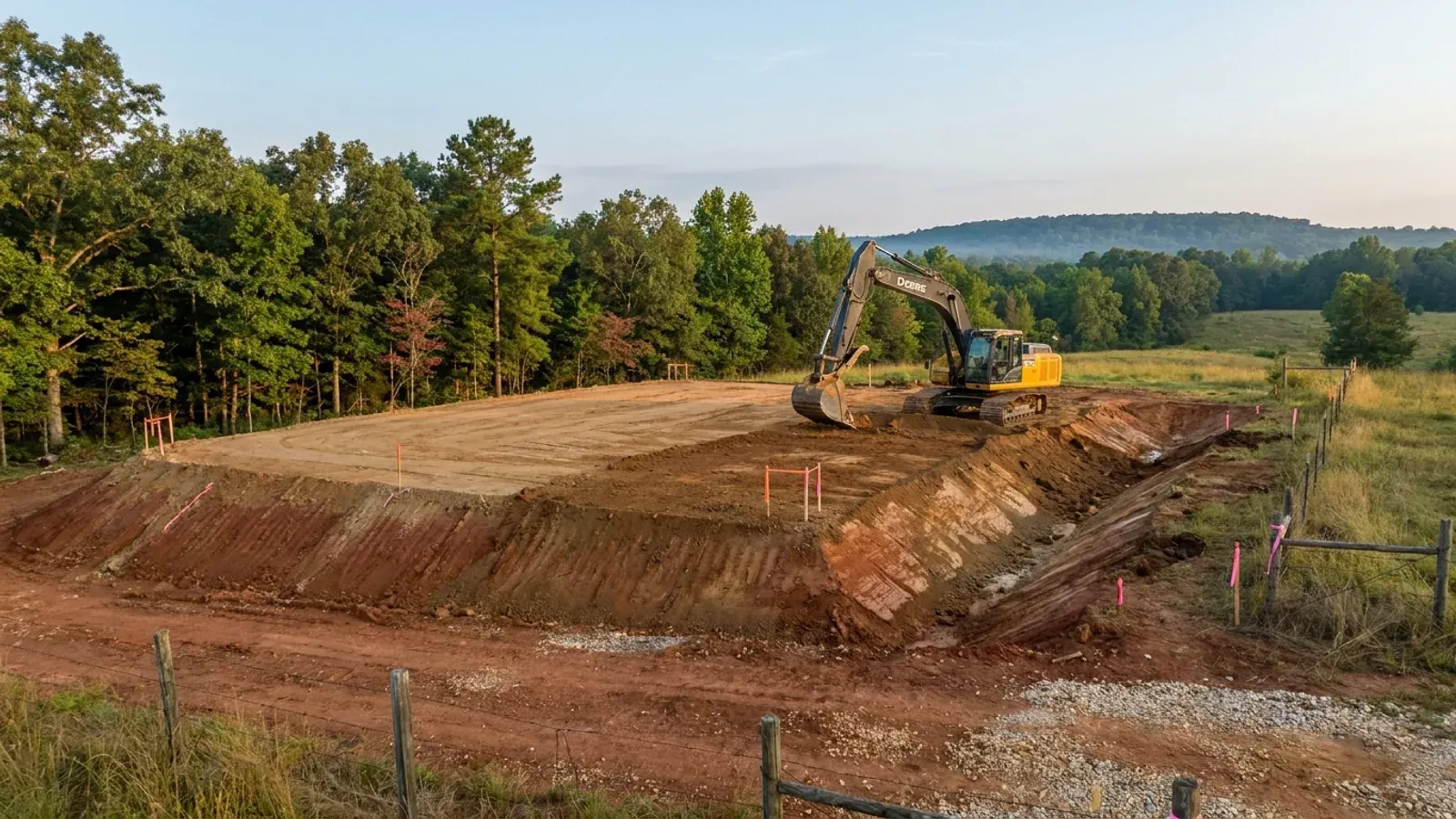
An excavator grading a compacted building pad on a cleared lot, with survey stakes and a drainage swale visible.
Below the slab

The expensive surprises are in the ground, not the building

What moves an Arkansas budget is usually below grade, and the state hands you a different problem depending on where you stand. In the Delta the issue is shrink-swell clay that moves with the season, and it is the reason a wide, light building with a big slab and a big door opening is the shape most at risk. Along the Fall Line there is a second, separate clay belt with nothing to do with the Delta at all. Up in the Ozarks the question inverts: what matters is not what the slab sits in but what is under it, because that limestone is full of solution cavities and the collapses arrive with no prior indication at the surface. And on Crowley's Ridge, where Jonesboro and Paragould sit, it is fine wind-blown loess that stands up in a vertical cut and then erodes out from under whatever you put on it. The same ground decides your wastewater system, which is the gate that most often moves a rural build's schedule — and it is soils that decide it, not the size of the house. So the site work, the foundation and the wastewater get resolved together rather than one at a time. We price the dirt before we price the building.

What a build looks like

Three stages every Pine Bluff project passes through, from a raw parcel to a finished home. Site work first, because that is where the budget is decided.
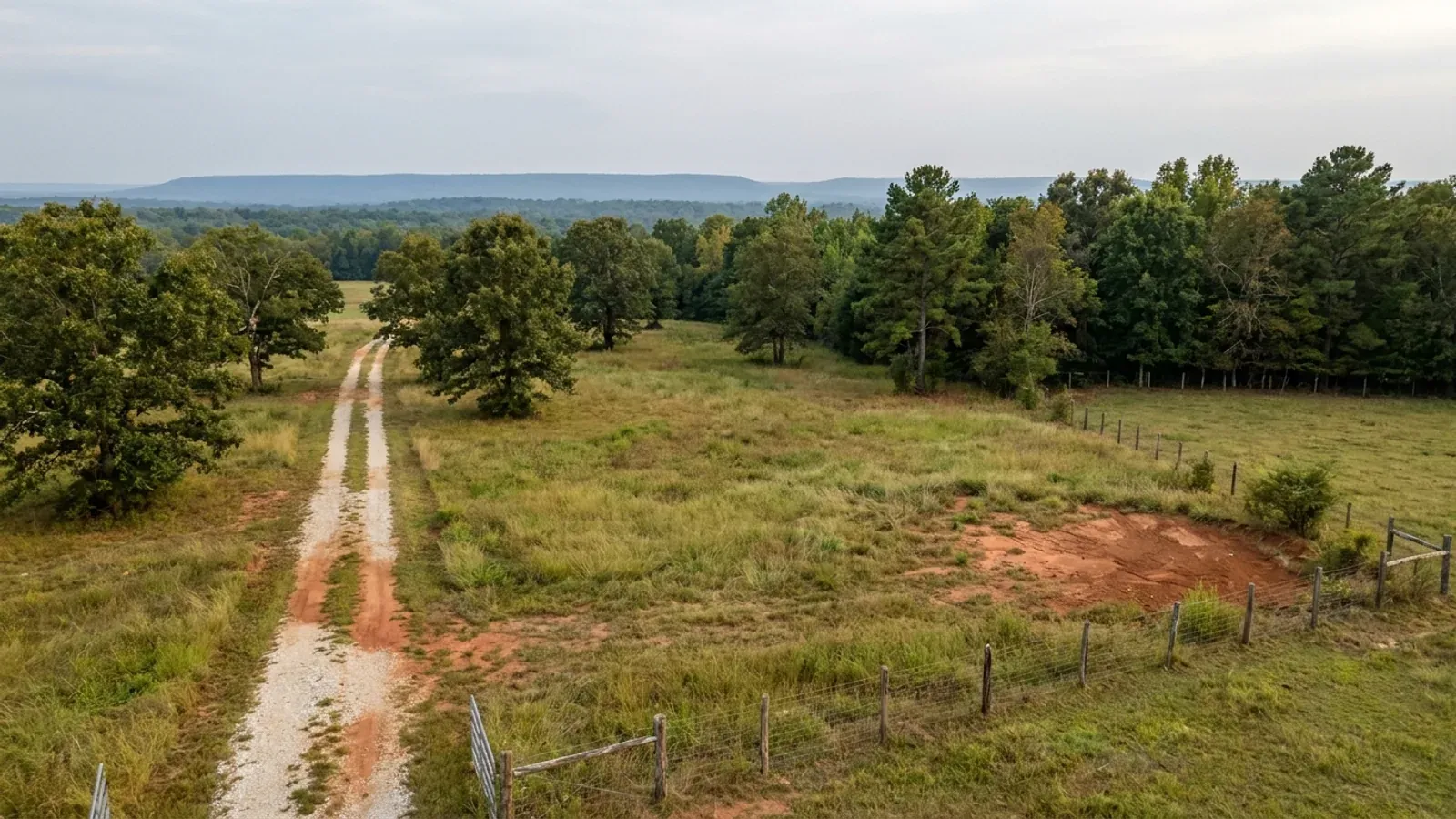
Aerial view of an undeveloped rural lot with cleared grass, an oak and hickory treeline with shortleaf pines, and a pale gravel access track.
Stage one

The parcel

Zoning, setbacks, flood zone and utility access get checked before anything is drawn.

An excavator grading a compacted building pad on a cleared lot, with survey stakes and a drainage swale visible.
Stage two

Pad and permit

Clearing, grading and a compacted pad, while the submittal works through whichever office issues the permit where you are building.
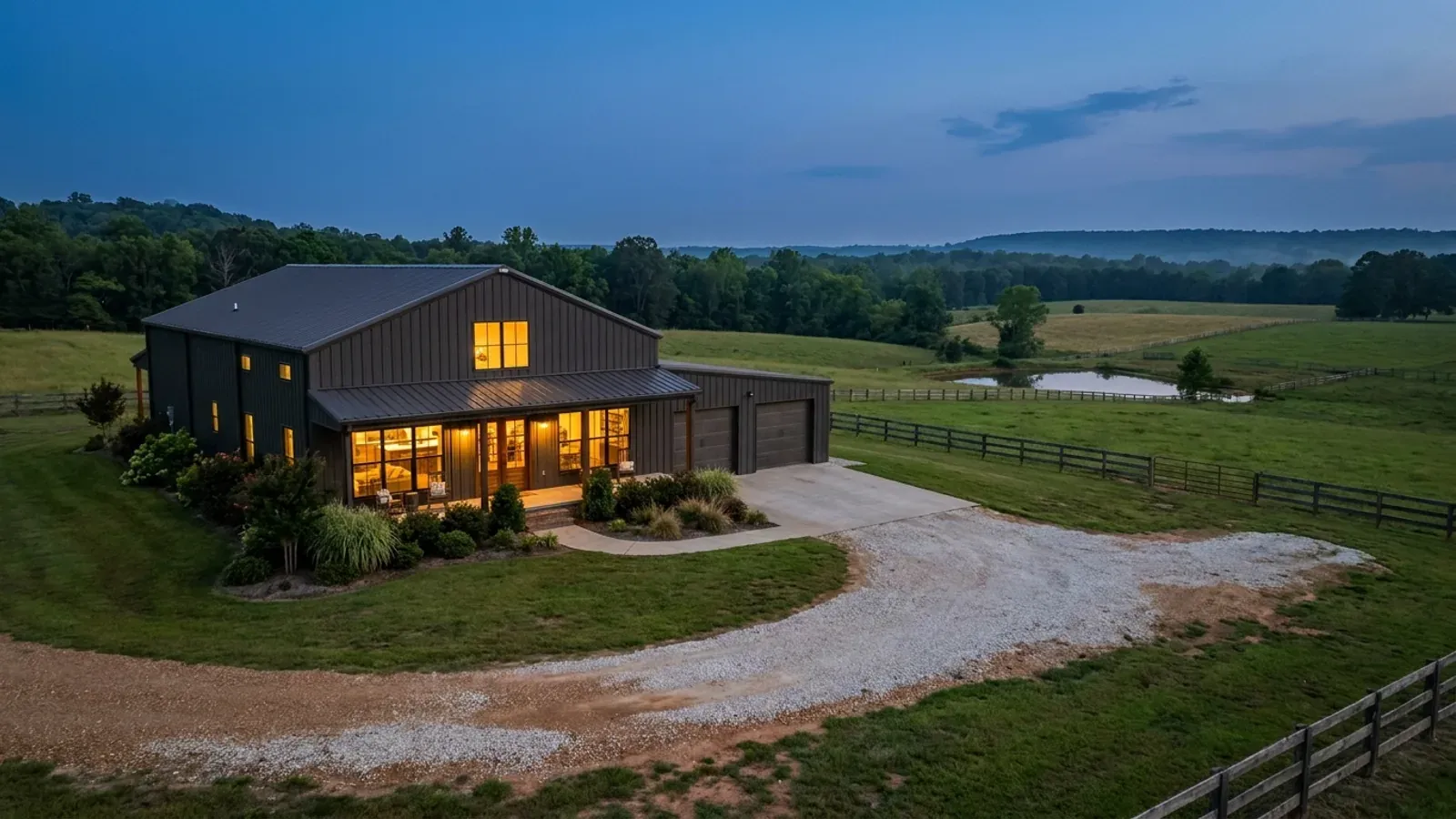
A finished barndominium at dusk with warm interior lighting glowing through its large windows.
Stage three

Frame to finish

Shell erected and dried in, then systems, insulation and interior finish through to CO.

Those are the rules where you are building in Pine Bluff. Tell us what you want to build and we will draw it to them.

Where we build around Pine Bluff

Jefferson County and the rural land around it. The buildable acreage for a project this size usually sits outside the city limits, which is frequently what changes who issues your permit.

The Pine Bluff service area, including the rural acreage outside the built-up edge, which is where the parcels big enough for a build like this usually sit. The map marks the territory we build in. It is not a branch location, and there is no office at this pin.

Nearby areas we build in

Others we cover nearby. One may be a county, another a city inside it — and since March 2025 the soft edge between them is gone, because the cities' extraterritorial jurisdiction was abolished outright and that land reverted to the counties. So the office that issues the permit, the fees it charges, the zoning and whether anyone publishes design criteria at all can differ from one card to the next, and the boundary that decides it may have moved recently.

Building in Pine Bluff: common questions

9 questions we get asked most often about building in Pine Bluff. If yours is not on the list, ask it directly.

Is Pine Bluff actually a good place to build a barndominium?
Be honest with yourself about which half of the question you are asking. If you already own a lot inside the city, or you want an infill build, an addition or a pole barn shop on a platted parcel, Pine Bluff is one of the more straightforward jurisdictions in Arkansas to work in: there is a real counter, a published fee, a zoning ordinance you can read, and a thirty-day path for a small lot split. If what you want is a house with a shop on real acreage, the picture is more complicated, and the numbers say so. The 2022 Census of Agriculture counts 375 farms in Jefferson County holding 296,354 acres. Forty-six of those farms run 2,000 acres or more and hold 206,367 acres between them, seventy percent of all the farmland in the county. Add the 34 farms between 1,000 and 1,999 acres and 80 farms hold 86 percent of it. The 184 farms under 100 acres hold 7,272 acres in total, two and a half percent. Sixty-eight percent of the county's farmland is irrigated, and irrigated row-crop ground does not come apart into ten-acre homesites. The published median farm size of 105 acres is a real number but a misleading one: it is measuring the long tail of small tracts, not the ground. The good news is that the answer is inside the same county. Jefferson County is 35 percent forest, and the timbered southern and western half of it is West Gulf Coastal Plain rather than Delta. That is where ordinary-sized tracts trade, and it continues straight into Cleveland County.
Who issues the permit in Pine Bluff, and what does it cost?
The City of Pine Bluff inspection department does, and unlike most Arkansas jurisdictions the fee is published in the code rather than on a counter handout. Section 7-47(3) amends Section 103.1 of the adopted building code to name the inspection department as the enforcement agency and the department head as the building official. Section 7-47(4), rewritten by Ordinance No. 6798 on 17 April 2023, prices the permit on construction valuation in six bands: nothing under $500 unless an inspection is needed, then $15.00; $15.00 for the first thousand plus $6.00 for each additional thousand up to $50,000; $204.00 plus $4.00 per thousand to $100,000; $504.00 plus $2.00 per thousand to $500,000; $1,304.00 plus $1.00 per thousand to $1,000,000; and $1,804.00 plus $0.50 per thousand above that. Section 7-10 adds a mandatory plan review for any new single-family residence at half the permit fee, non-refundable and payable when the plans go in. On a $250,000 valuation that is $804.00 and $402.00. A certificate of occupancy is $75.00 under section 7-49. A second or additional inspection is $35.00. A permit extension or renewal is $30.00. A zoning permit is $25.00 and is required alongside the building permit for both principal and accessory buildings. Electrical, plumbing and mechanical work carry their own permits: all electrical permit fees are $20.00 plus a per-circuit charge starting at $6.00 a circuit, plumbing is $5.00 per fixture with $30.00 for a new water service, and reinspections are $35.00. Building without a permit costs three times the permit fee and blocks any further permits until it is paid.
How big can the shop be, and can I attach it to the house?
Pine Bluff answers this differently from every other Arkansas city on this site, and the difference is worth understanding before you draw anything. There is no square-foot cap on an accessory building here and no rule that it must be smaller than a percentage of the house. What governs instead is coverage, placement and definition. In R-1 the total building coverage of the lot may not exceed 45 percent, accessory buildings must stand at least five feet from any property line, and they may be located only in side and rear yards. In A-R the main building and all accessory structures together may not occupy more than 25 percent of the tract, which on the district's five-acre minimum is 54,450 square feet, so coverage will not be your constraint out there. The definition at section 29-2 is where the barndominium question actually turns: where part of the wall of an accessory building is part of the wall of the principal building, or where an accessory building is attached to the principal building in a manner as by a roof, that accessory building shall be counted as part of the principal building. Attach the shop under one roofline and it is simply part of the house, subject to the house's setbacks and to the same coverage figure. Two more limits to note. The same section bars semi-truck trailers, railroad cars, tents, yurts, canopies, portable storage containers, mobile homes, manufactured housing, portable offices and recreational vehicles from serving as accessory buildings, and requires both a zoning permit and a building permit before one is erected. And a private garage is defined as holding no more than three vehicles, or one per family housed in the building, whichever is greater.
What happens if I buy land outside the city limits?
For building purposes, almost nothing happens, and that is the finding rather than a gap. Arkansas county land-use control is a deliberate two-step opt-in: A.C.A. 14-17-203(a) says a county judge may create a county planning board with the approval of a majority of the quorum court, and only then may the court adopt a zoning ordinance, which 14-17-209(c) provides shall be observed through denial of the issuance of building permits and use permits. Jefferson County has taken neither step. Its published department list has no planning department, no zoning department and no building department, and unlike Faulkner and Craighead counties it has no Association of Arkansas Counties codified code published on Municode. So there is no county building permit, no county plan review, no county inspection sequence and no county certificate of occupancy. Two county offices do touch land. The Office of Emergency Management at 101 West Barraque issues floodplain development permits, and given how much of this county sits in mapped floodplain that one is not optional. The Environmental Office enforces county codes for road and land use, issues permits and deals with conditional use permit holders. What still binds everywhere in Arkansas regardless: the Arkansas Fire Prevention Code as the governing technical standard, the state plumbing code, which A.C.A. 17-38-103(a) makes minimum standards statewide in application to all types of buildings, private or public, rural or urban, and the state licences held by electricians, plumbers and HVACR mechanics. Onsite wastewater is the Arkansas Department of Health's, and on this ground that is the real gate.
What is the ground like, and what does it do to a slab?
It depends which side of the county you are on, and the split is sharp. North and east of Pine Bluff is Mississippi Alluvial Plain, and the dominant soil is Perry: roughly 146,600 acres of it in the Jefferson and Lincoln survey area, more than any other major component. The NRCS Official Series Description for Perry, a very-fine smectitic thermic Chromic Epiaquert, puts the average clay content of the 10 to 40 inch control section at 60 to 85 percent, names montmorillonite as the dominant clay mineral, and describes the soils as poorly drained with very slow permeability. That is a shrink-swell clay: it changes volume seasonally, and under a long slab that becomes differential movement, every year, forever. Portland, the third most extensive component at about 78,400 acres, carries a seasonal high water table within twelve inches of the surface from December through May. South and west the story changes to Coastal Plain terraces carrying Savannah, Sacul, Sawyer and Smithdale, where the problem is not shrink-swell but a fragipan: the Savannah series description puts depth to the fragipan at 16 to 38 inches, describes the Btx horizon as very firm and brittle when moist, and records a water table perched above the pan at 1.5 to 3.0 feet in wet seasons from January to March. Practically, that means the geotechnical report decides the foundation here rather than confirming it, and the two halves of the county call for different answers. On Perry clay a stiffened slab or piers to competent bearing, with the moisture regime under the slab controlled and the site graded to drain, is the conversation. On the fragipan side, the drainage design is the foundation design.
How much of this county floods, and how do I check a parcel?
Pine Bluff sits on the Arkansas River and the levee system is the reason most of the surrounding ground is farmable at all. The Arkansas Levee Task Force, created by Executive Order 19-10, had the Arkansas Geographic Information Systems Office overlay Corps of Engineers National Levee Database leveed areas onto county assessor tax parcels, and Jefferson County needed two volumes. The northern report records 129,353.12 acres of parcels intersecting the leveed area with 120,347.70 acres inside it; the southern report records 142,219.96 acres intersecting with 134,372.45 acres inside. That is about 254,720 acres of a 556,770-acre county behind a levee. The same reports map the Corps' June 2019 forecast Arkansas River flood across 22,002.85 acres in the north and 25,003.78 acres in the south. The federal soil survey agrees from a different direction: NRCS flood frequency ratings put 100,699 acres in the Jefferson and Lincoln survey area as occasionally flooded and 67,285 acres as frequently flooded, and the Perry series description states plainly that these soils are flooded for short periods nearly every year unless protected by levees. Checking a specific parcel means three calls, not one. Inside the city, the inspection department administers the Flood Damage Prevention Code adopted by reference in Ordinance No. 6273 and holds the current maps; the floodplain development permit fee is $75.00 under section 11-1(b). Outside it, the county Office of Emergency Management issues the permit. And if you are platting, section 25-12 requires finished minimum floor elevations and existing lot elevations on every lot of any subdivision wholly or partly in the 100-year floodplain.
Can I put in a septic system out there?
Assume it is the hardest part of the site work here and budget accordingly. A USDA-NRCS Soil Data Access query of the septic tank absorption field interpretation across the Jefferson and Lincoln survey area returns 680,756 acres rated Very limited and 142,184 acres rated Somewhat limited. The Not limited class does not appear at all: of the acreage NRCS rates, roughly 83 percent is the worst class and the rest is the middle one. The reasons are the same ones that shape the foundation. Perry and Portland clays have very slow permeability, so effluent has nowhere to go laterally. The water table is the other half: the same database's April-to-June figures put 72,871 acres with water within 30 centimetres of the surface and a further 407,058 acres between 30 and 60 centimetres, so about 480,000 acres carry a seasonal high water table inside two feet in late spring. On the Coastal Plain side the fragipan does the same job for a different reason, perching water above a dense pan at a foot and a half to three feet down. None of this makes a site unbuildable. It does mean the answer is often an engineered or alternative system rather than a conventional trench field, that the designer's soil evaluation is the first professional you hire rather than the last, and that a percolation result from a neighbouring tract tells you very little. The permit is the Arkansas Department of Health's, and the licensed designer and installer are state-licensed regardless of whether any city or county is issuing a building permit.
Which building code applies here, and did anything change in 2025?
The state code applies everywhere in Arkansas. The Arkansas Fire Prevention Code, 2021 edition, took effect on 1 January 2023, and its Volume III is the 2021 International Residential Code with Arkansas amendments. The Arkansas Department of Labor and Licensing states on its own Contractors Licensing Board pages that the code applies statewide, even in rural and unincorporated areas. What varies is whether a counter exists, and inside Pine Bluff one does. The city's own adopted list is worth reading carefully because it is idiosyncratic: section 7-46 adopts the 2021 International Existing Building Code as the city's building code, section 7-181 adopts the 2012 International Residential Code as the property maintenance code, section 7-226 the 2021 International Mechanical Code, section 7-241 the 2018 Arkansas State Plumbing Code and the 2018 Arkansas Fuel Gas Code, section 7-161 the 2020 National Electrical Code with all appendices except Appendix H, and section 7-1.1 the 2014 Arkansas Energy Code. Section 7-47(2) then reads referenced codes as meaning whatever the city has adopted. Arkansas allows a local jurisdiction to make the state code more stringent and never less, so the state residential code remains the floor beneath all of that. As for 2025: Act 314, approved 18 March 2025, repealed A.C.A. 14-56-413 outright and abolished municipal extraterritorial planning jurisdiction across Arkansas. Under the repealed statute a city of Pine Bluff's census size reached one mile past its limits. Pine Bluff's own Chapter 25 has not been updated to match and still defines and applies to a territorial jurisdiction; the code comparative table shows that chapter was last touched in 2003.
If Jefferson County is the wrong place for acreage, where should I be looking?
Three directions, and the federal farm data makes the case better than any description. Cleveland County, immediately south-west, is the other half of the Pine Bluff micropolitan area and is the closest match to what most buyers actually want: 208 farms, only 10.3 percent of its 382,582 acres in farms, and, in the 2022 Census of Agriculture's own table, no farm in the county at 2,000 acres or more. It is timber country rather than row crop, about 83 percent forest, with roughly 7,200 people spread over 598 square miles, and timber ground trades in ordinary pieces to ordinary buyers. Grant County, west toward Sheridan, is the same coastal-plain timber and the highest forest share of any county in Arkansas, and unlike its neighbours it is growing. Lincoln County, straight south to Star City, shares the soil survey area with Jefferson and has 287 farms across 212,791 acres with a median farm of 150 acres, which is a workable size even though the Delta influence is stronger there. And do not write off Jefferson County itself: the constraint is the irrigated cropland north and east of the city, not the whole county. The timbered south and west sits on marine deposits rather than river alluvium, carries Savannah and Sacul and Smithdale rather than Perry, and is the half where you should be driving. One thing carries across all four lines: none of them has a county building department, so the appraiser, the lender and the insurer become the inspection regime, and a stamped engineer's design plus a documented inspection trail is worth more out there, not less.

Building in Pine Bluff?

Start with the plan. Tell us what you want to build and we will draw it, then confirm which office issues the permit for your parcel, what it will let you put there, and what wind load it has to meet. That conversation costs nothing.